
ADER

Among the numerous French automobile manufacturers that appeared at the beginning of the twentieth century, Ader occupied a distinctive position. Its origins were closely connected with the remarkable career of Clément Ader (1841–1925), an engineer and inventor whose interests extended from railways and electrical communications to aviation and internal-combustion engines. Although he is remembered principally for his pioneering experiments with powered flight, his contribution to early automobile engineering deserves particular attention. The cars bearing his name were distinguished by unusual engine configurations, especially the extensive use of V-arranged cylinders at a time when most manufacturers were adopting more conventional layouts.
Origins and Engine Development
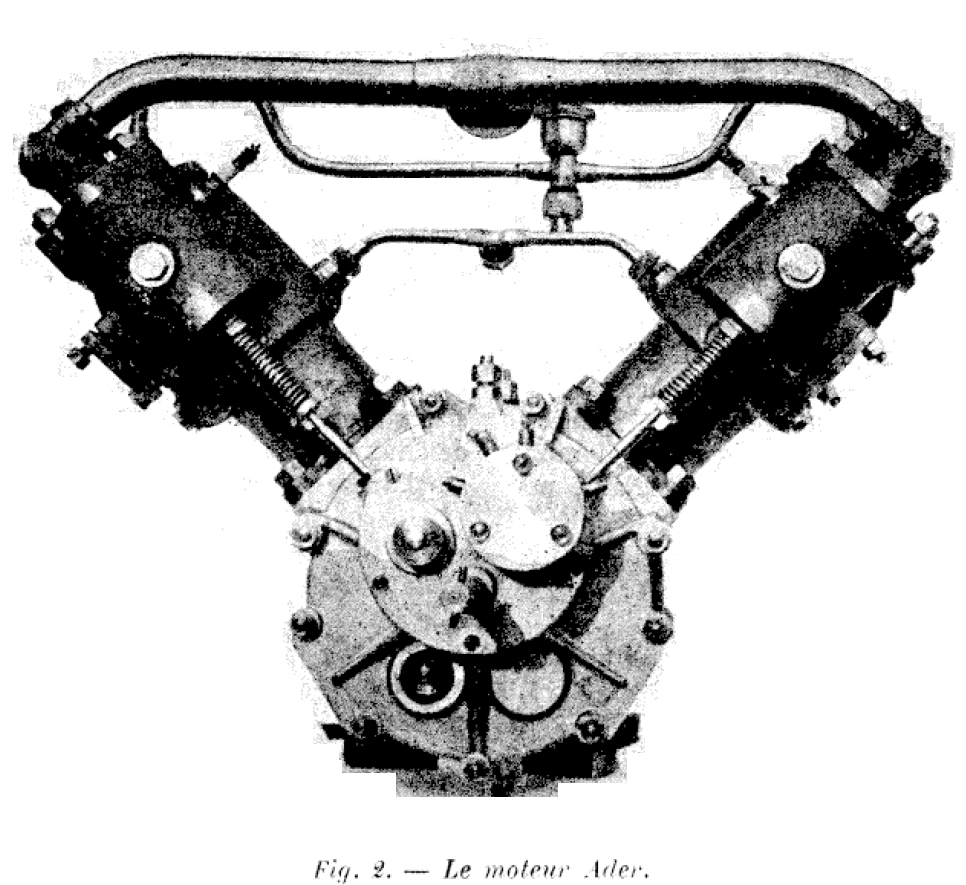
Ader's work on automotive propulsion developed naturally from his earlier research into lightweight engines for aviation. In May 1898, he patented improvements to engines intended for several forms of transport, including aircraft, boats and automobiles. A further patent, filed on 3 September 1898, described a petrol engine with two cylinders arranged at an angle of 90 degrees. The specification also contemplated extending the design by adding further pairs of cylinders. This arrangement established the technical foundation for the distinctive V-type engines subsequently associated with the Ader name. On 21 December 1900, Ader transferred his patent rights to the Société Industrielle des Téléphones, which had already registered the Ader automobile and engine trademark earlier that year. The history of the automobile marque was therefore closely linked not only to its inventor but also to the industrial company responsible for exploiting his designs.
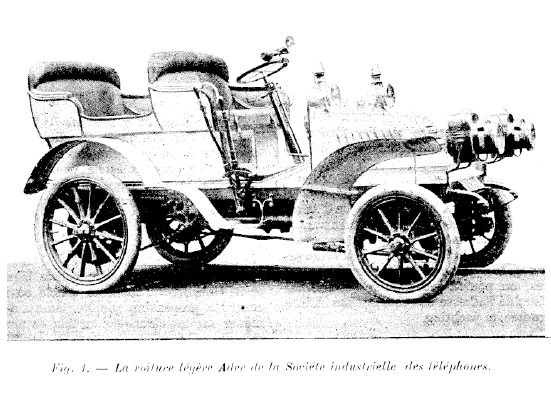
Automobile production began around 1900 at Levallois-Perret, near Paris. The earliest Ader car was equipped with a V-twin engine of approximately 900 cc, developing 8 hp and transmitting power to the rear wheels by chain drive. This was followed by a more powerful 12 hp twin-cylinder model in 1902. The V arrangement permitted a compact grouping of the cylinders and reflected Ader's long-standing interest in obtaining useful power from relatively light machinery. The company progressively expanded its mechanical designs rather than limiting itself to a single engine type, and its early cars also employed alternative transmission arrangements, including shaft drive.
One of the most interesting features of the Ader programme was the progressive development of multi-cylinder engines from the original V-twin concept. By coupling two V-type twin-cylinder units, the company developed a four-cylinder engine, while a further extension of this principle produced an eight-cylinder engine. Unlike the conventional straight-four engines increasingly favoured by other manufacturers, these designs continued to employ the V arrangement. The resulting engines represented an ambitious attempt to combine compact dimensions with greater power output, and they became the most distinctive technical feature of the marque during its early years.
Competition, Expansion and the End of Production
Like many French manufacturers of the period, Ader regarded long-distance automobile competition as an opportunity to demonstrate the capabilities of its machines. Two Ader cars participated in the Paris–Vienna race of 1902, although without achieving particularly notable results. Greater attention followed in 1903, when the company entered seven automobiles in the Paris–Madrid race. According to the historical account by Nick Georgano, the entry comprised one V-twin, three V-4s and three V-8s. The latter, developing a nominal 32 hp, constituted one of the earliest applications of an eight-cylinder V engine to a racing automobile. Three V8 racing cars were constructed for the event, employing an engine developed by combining two four-cylinder V assemblies on a common crankshaft.
The Paris–Madrid competition, held on 24 May 1903, ended prematurely at Bordeaux following a series of serious accidents. Nevertheless, the Ader entry provided a useful demonstration of the marque's mechanical capabilities. All three V8 cars reached Bordeaux, although their recorded performances were not sufficient to challenge the leading competitors in the light-car category. Contemporary reports also noted the arrival of four Ader voiturettes. The episode was significant less for outright speed than for the reliability demonstrated by these experimental machines under the demanding conditions of early road racing. The V8 did not subsequently become a regular production engine, but its construction remains an important achievement in the early history of multi-cylinder automobile design.
During 1903, Ader continued to develop its range of touring automobiles, including models fitted with V-twin and V-four engines. The adoption of more conventional four-cylinder engines gradually altered the character of the marque. By 1905 the company's catalogue included vertical four-cylinder models rated at 16, 20 and 25 hp. The smaller models could be supplied with chain or shaft transmission, while the more powerful 25 hp model retained chain drive. This change reflected a broader tendency within the French automobile industry towards standardised engine arrangements and increasingly established methods of construction.
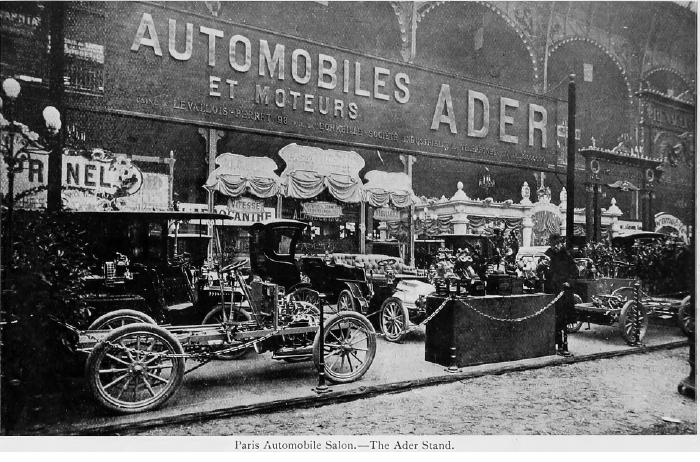
The disappearance of the unusual V-engined models also deprived Ader automobiles of much of their original mechanical individuality. By 1906 the V configuration had effectively disappeared from the regular automobile range, and production of Ader cars came to an end around 1907. The precise commercial reasons for the marque's disappearance require further documentary investigation; the change in engine design alone cannot establish why the enterprise ceased manufacturing. Its brief history nevertheless illustrates the experimental character of the French automobile industry during the years preceding the widespread standardisation of motorcar construction. Ader's lasting importance lies particularly in his early work on V-type internal-combustion engines and the application of these designs to automobiles at a remarkably early stage in their development.
Historical Sources
- Institut national de la propriété industrielle (INPI), Clément Ader: 35 Years of Patented Innovations, including French patent No. 281081, filed 3 September 1898.
- Associazione Italiana per la Storia dell'Automobile (AISA), Motori leggendari III: il V8 Ader, 20 June 2018.
- La Locomotion Automobile, 28 May 1903, contemporary report on the Paris–Madrid automobile race.