
Reviews of the Book
John A. Peterson
Panhard Club USA · November 2026
“I have just read this great work by Mr. Vershinin. It is something that all car buffs of the early years must read. I thought I knew a lot of facts of this period but this immense work gave me so much more information.”
The time spent to research this book has to be something on the order of a couple of years. He puts forth the background of both Emile Levassor and Rene Panhard and their contemporaries as well as competitors to build such a great story that many times while reading this I thought I was reading the script of a period documentary movie. This is one helluva great read.
Read more
If you are at all interested in the Belle Epoque, this is the definitive bible for you. I really enjoyed the first half of the book with all the stories and facts of what and how Panhard & Levassor set the stage for future development of the automobile industry but I also learned how the company wouldn’t adapt to the changing environment and ultimately created their own limitation to their success for building cars in the period after World War I.
Again, I cannot tell you enough what a great work this is and I really recommend this for your library of car history and personally you will know so much more how the automobile started and succeeded with these great French cars.
John A. Peterson · November 2026
Philippe Krebs
Automotive historian · Descendant of Arthur Krebs
Comprendre la pensée technique des premiers ingénieurs de l’automobile en évitant l’écueil de l’anachronisme. Voici le défi que Vladimir Vershinin poursuit depuis de nombreuses années. En mobilisant ses multiples cultures il propose au lecteur de voyager dans tous les détails des dispositifs que ces ingénieurs visionnaires ont proposé au monde de l’automobile d’alors, et dont nous sommes redevables aujourd’hui.
Vivre en Europe vers 1900, c’est faire l’expérience de mutations technologiques radicales. Le fiacre à cheval et l’omnibus tiré par des chevaux côtoient la bicyclette moderne, le cab électrique, le tricycle ou l’automobile à pétrole et le tramway à vapeur. On se passionne sans distinction pour les séances de spiritisme comme pour les manifestations de l’invisible en physique.
Read more
Et pourtant concevoir un engin automobile qui puisse rendre des services utiles, fut une longue et chaotique affaire d’ingénieurs passionnés par cette idée. Pour y parvenir, il a fallu de véritables inventions, comme le petit moteur de Gottlieb Daimler, mais surtout une foi inébranlable dans la « cause automobile » qui donne l’énergie nécessaire à la résolution de la multitude des problèmes posés par ce pari quelque peu insensé : se déplacer par soi-même aussi loin que possible !
L’histoire de Panhard & Levassor montre que certaines innovations ont fait la une des journaux ou bien ont alimenté de retentissants procès entre industriels. En revanche d’autres innovations, telle l’angle de chasse – qui fait revenir le volant quand on le lâche dans un virage – ont fait une apparition tellement furtive que personne n’en parle à l’époque, et pourtant toutes nos automobiles d’aujourd’hui en sont pourvues.
Gottlieb Daimler, Édouard Sarazin, Louise Cayrol, Émile Levassor, René Panhard, Arthur Krebs, Charles de Fréminville ; combien cette lignée d’ingénieurs, à la fois industriels, inventeurs, organisateurs et commerçants, ont façonné l’automobile et marqué leur époque ? C’est ce que Vladimir Vershinin se propose de nous faire découvrir.
Philippe Krebs
About the Book
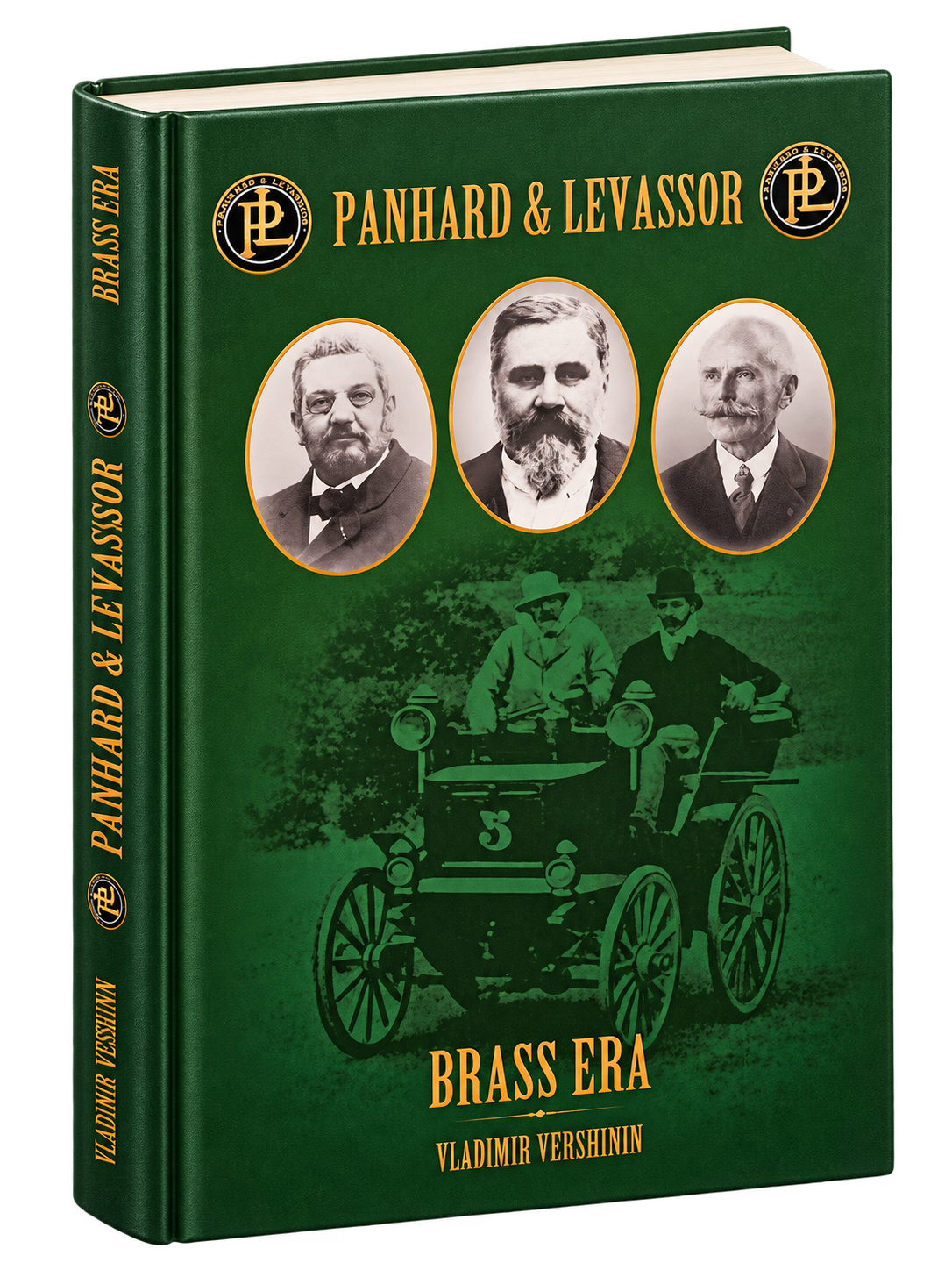
Panhard & Levassor Brass Era is a richly illustrated, 354-page historical and technical study of the birth and evolution of the automobile, from the nineteenth century to 1914. Based on eight years of research, the book traces the origins of Panhard & Levassor and the work of the engineers, inventors, and entrepreneurs who helped transform the automobile from an experimental machine into a practical means of transportation. It explores the company's pioneering role in the development of the automobile industry, its early production cars, and the great motor races that accelerated technological progress.
Beyond the historical narrative, particular attention is devoted to the engineering behind these remarkable machines: engines, carburetors, clutches, gearboxes, steering mechanisms, and suspension systems. Drawing on original archival documents, contemporary technical publications, historical photographs, and detailed engineering illustrations, the book explains not only what was invented, but also how these mechanisms worked and why they represented important steps in the evolution of the modern automobile.


