
ALCYON (1906–1928): From Bicycles to Automobiles
Alcyon is remembered above all for its bicycles, motorcycles and sporting achievements. Yet for more than twenty years the French manufacturer also built automobiles, from modest single-cylinder voiturettes to sophisticated four-cylinder racing machines. This lesser-known part of the firm's history reveals how readily engineering experience from the two-wheeled world could be transferred to the young automobile industry.
Edmond Gentil and the Origins of Alcyon
Alcyon was established at Neuilly-sur-Seine, on the western edge of Paris, by Edmond Gentil (1874–1946). Most historical accounts date the beginnings of the business to 1902, although 1903 also appears as the year of its formal establishment. Gentil had previously worked in the bicycle trade, including at Griffon, before setting up his own enterprise. Its early premises were at 4–6 boulevard Bourdon, Neuilly-sur-Seine.
The firm initially concentrated on bicycles, followed by motorcycles from 1904. For their engines, Alcyon developed an important relationship with the Swiss concern Zürcher & Lüthi, known by the initials ZL and associated with the Zédel name. Motorcycle racing and a rapidly expanding range of products gave the Alcyon name wider recognition. The move into automobiles was therefore not an isolated experiment: it was an extension of an established mechanical business.
The First Voiturettes, 1906–1908
At the Paris Motor Show of 1906, Gentil presented two automobile models, with seating for two or four passengers. Contemporary and later descriptions emphasised their light construction and a chassis described as monobloc. The early range included single-cylinder cars of approximately 7–8 horsepower and a small four-cylinder model of approximately 12 horsepower.
Alcyon's light voiturettes were conventional in their general layout but more technically substantial than their small dimensions might suggest. Period descriptions refer to three-speed gearboxes, shaft drive and disc clutches. The automotive press of 1907 illustrated the Alcyon 8-horsepower single-cylinder engine, its clutch, chassis and rear axle in considerable detail. The company's own 1907 catalogue offered an 8–9-horsepower, two-seat single-cylinder voiturette at 3,600 francs.
In advertising, the small Alcyon was promoted as a practical and robust means of transport, rather than merely a recreational machine. The single-cylinder model acquired the slogan “la vraie voiture du médecin” — “the true doctor's car” — an allusion to the need for reliable transport over the often-demanding roads encountered on medical rounds.
Alcyon's entry into automobile competition followed almost immediately. Twin-cylinder cars participated in the 1907 and 1908 Coupes des Voiturettes. These early racing appearances demonstrate that the brand's automobile programme extended beyond the showroom.
A Broader Range and Serious Racing Ambitions
During the following years, Alcyon continued to offer different engine configurations. Its catalogue included single- and twin-cylinder cars, while the four-cylinder range developed considerably. The marque was connected with engines of the Zürcher/ZL family, although published descriptions also refer to Alcyon-branded single-cylinder units. Given the variations between years and models, it would be misleading to attribute every Alcyon engine to a single manufacturer.
By 1911, Alcyon was participating in more demanding lightweight-car competition, including events at Boulogne-sur-Mer. The firm’s racing ambitions were growing beyond the relatively modest voiturettes of its first years.
The most interesting development appeared in 1912. In its issue of 22 June, La Vie automobile described three Alcyon racing cars entered for the Coupe de l'Auto, to be driven by Barriaux, Page and Arthur Duray. Their four-cylinder engines had a bore and stroke of 85 × 132 mm, with four valves per cylinder — sixteen valves in total. The journal also recorded rocker-operated valves, a disc clutch, four forward speeds, shaft transmission and bodywork designed to reduce aerodynamic resistance.
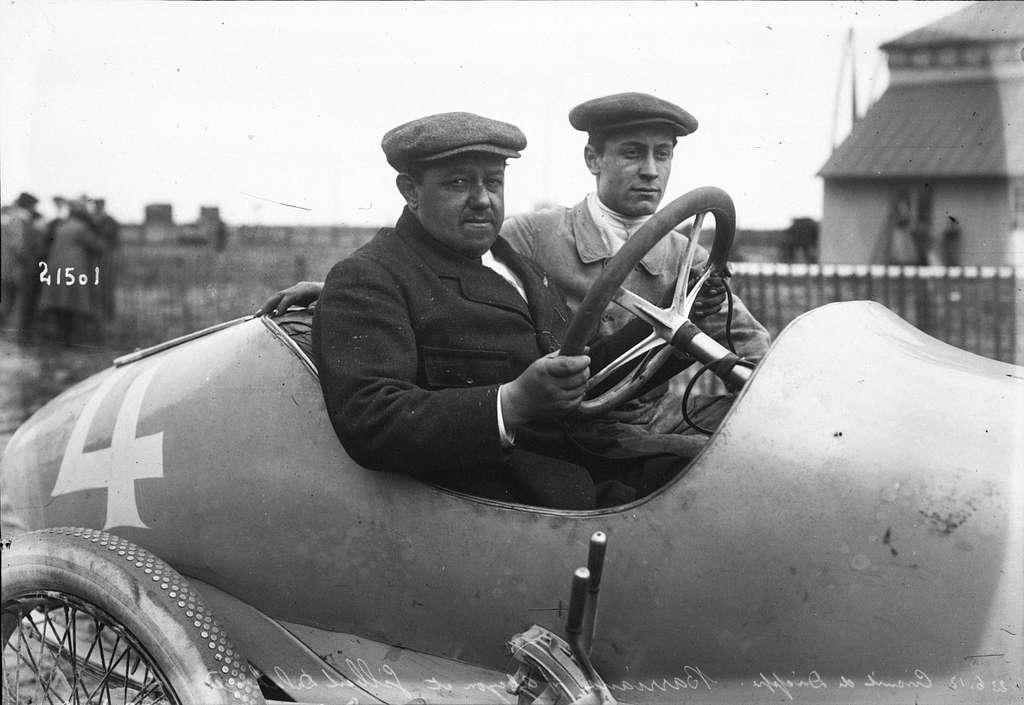
The 1912 Coupe de l'Auto was run alongside the Automobile Club de France Grand Prix at Dieppe on 25–26 June, but the two events had distinct regulations and classifications. The Coupe limited engine capacity to three litres. Arthur Duray finished sixth in the Coupe de l'Auto classification, in 18 hours, 28 minutes and 55 seconds; he was tenth in the combined finishing order. This distinction matters: describing him simply as sixth in the entire Grand Prix would be inaccurate.
From Neuilly to Courbevoie
Industrial growth prompted a move in 1912 to larger premises at 40–52 rue de la Garenne in Courbevoie, a street now known as rue Jean-Pierre Timbaud. Alcyon was no longer a small workshop. Its business comprised bicycles and motorcycles, automobile production and associated mechanical manufacturing.
Automobiles remained in the catalogue on the eve of the First World War. An Alcyon prospectus of 1913 advertised a “Tour de France” touring car and listed the chassis at 6,000 francs, before bodywork. Such documents show that the firm's automobile ambitions were not confined to racing specials. Nevertheless, the surviving documentation does not establish precise annual automobile output, and published claims of spectacular commercial success should be treated cautiously.
War, Cyclecars and the End of Car Production
The First World War interrupted Alcyon's pre-war expansion. The company remained active, but its post-war resources and priorities increasingly favoured motorcycles and bicycles. Although automobile production was not immediately abandoned, the scale and character of the range changed markedly.
In the early 1920s, a little-known two-litre Alcyon, associated with the Lyon agent Giroux and sometimes called the Alcyon G.L., appeared in regional sporting events. More characteristic of the surviving post-war line were small cyclecars: accounts mention a twin-cylinder machine of approximately 497 cc and a simpler single-cylinder two-stroke version of about 350 cc. The last Alcyon cars have also been compared with contemporary 500 cc Sima-Violet designs.
The automobile branch came to an end in 1928. The Alcyon name, however, survived in the much better-known two-wheeled business for decades afterwards. That different chronology is essential: 1928 marks the end of Alcyon automobile manufacture, not the end of the company or its other products.
Alcyon's Place in French Automobile History
Alcyon's story is particularly revealing because it bridges two distinct aspects of early motoring. On one hand were lightweight voiturettes advertised for everyday professional use; on the other were purpose-built racing cars whose valve gear, transmission and aerodynamics were technically ambitious by the standards of 1912.
The firm's automobile production never achieved the lasting prominence of its bicycles and motorcycles. Yet the surviving catalogues, technical articles, racing results and photographs establish Alcyon as a genuine — and unusually versatile — contributor to France's early motor industry.
Sources and Further Reading
- Fédération Française des Véhicules d’Époque, “Alcyon Automobiles”: company foundation, early cars and industrial locations.
- Jean-Pierre Gross, “Alcyon Automobiles”, Société Historique de Courbevoie: company history and post-war products.
- La Vie automobile (1907), pp. 330–332, illustrations of the Alcyon 8-hp engine, clutch and chassis. Digitised index: Conservatoire numérique des arts et métiers (Cnum).
- Charles Faroux, “Le Grand Prix de l'ACF”, La Vie automobile, 22 June 1912: contemporary specifications of Alcyon's 16-valve racing cars.
- “Le Grand Prix de l'ACF et la Coupe de l'Auto”, La Vie automobile, 6 July 1912: 1912 classification and times.
- Alcyon marque entry, PreWarCar, drawing on G. N. Georgano's motor-car encyclopaedia: model development and technical details.
- Les Vieilles Chaînes Villefranchoises: reproductions of Alcyon catalogues and price lists, 1907–1922.