
The 8 HP Alcyon Voiturette in 1907: A Contemporary Technical Examination
A study of the single-cylinder Alcyon based on Maurice Sainturat’s article “La Voiturette Alcyon,” published in La Vie automobile (1907), pp. 330–332.
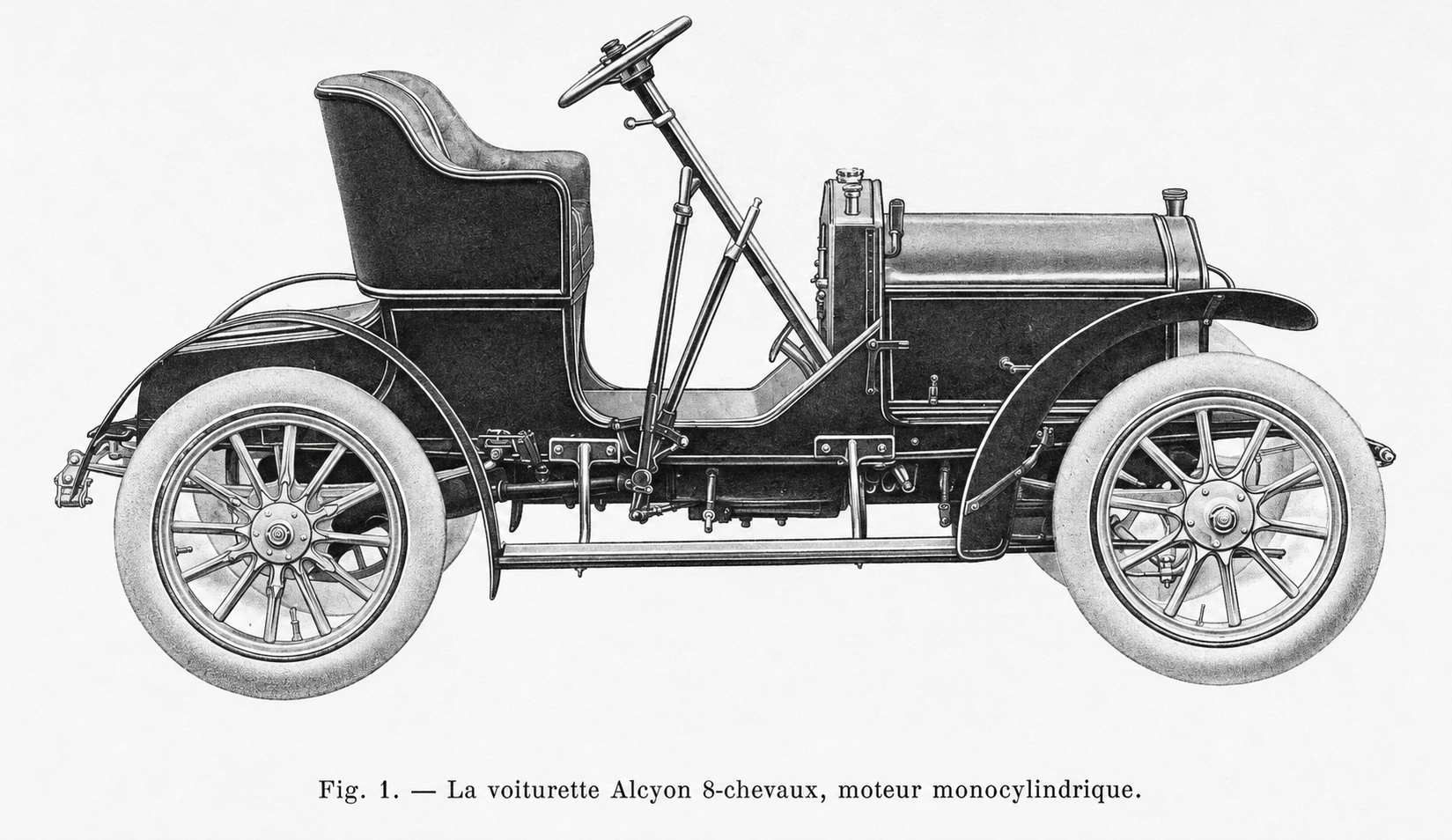
In 1907, when the affordability of the motor car was still a difficult engineering and commercial problem, the French periodical La Vie automobile published an unusually detailed examination of the 8-horsepower Alcyon voiturette. The article, written by Maurice Sainturat, was more than a catalogue description. It considered the compromises required to make a comparatively inexpensive car without sacrificing dependable mechanical construction.
Sainturat’s central argument was that the small automobile did not succeed merely by being mechanically rudimentary. Buyers expected the controls and convenience of larger cars, but at a much lower price. Alcyon’s response was to simplify production and assembly while retaining certain components more commonly associated with substantial touring cars.
The Single-Cylinder Engine
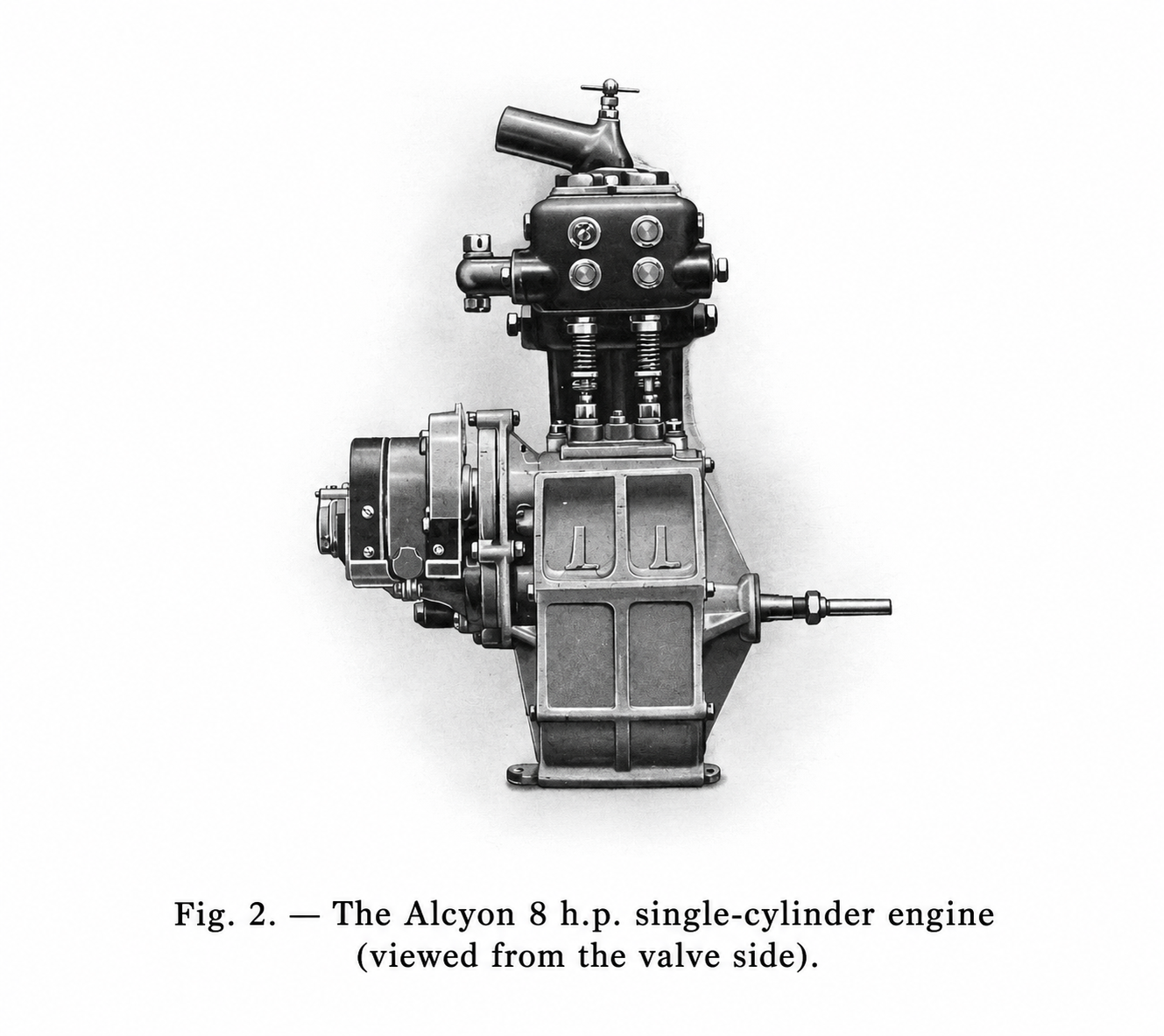
The Alcyon engine had a 105 mm bore and a 120 mm stroke. These dimensions correspond to a calculated displacement of approximately 1,039 cc, although Sainturat himself gave no displacement figure. He described the engine as developing a normal output of 8 horsepower, a contemporary designation that should not be confused with a modern dynamometer measurement.
Both inlet and exhaust valves were mechanically operated by a camshaft enclosed within the crankcase. They were positioned laterally and made interchangeable, an arrangement praised for its accessibility. The aluminium crankcase housed two large, heavy flywheels intended to smooth the engine’s operation at low speed. The timing cover was made of bronze, and the bearings incorporated oil-retaining rings.
These details deserve attention. A single-cylinder engine of just over one litre would deliver its torque in widely spaced impulses, placing considerable demands on the clutch and transmission. The two substantial flywheels were a practical way of evening out its rotation. Sainturat regarded this refinement as compatible with, rather than contrary to, economy.
Cooling, Lubrication and Ignition
The cooling system relied on thermosiphon circulation, using the natural movement of heated and cooled water rather than a mechanically driven circulating pump. Sainturat considered this both economical and mechanically simple.
Engine lubrication was not an automatic pressure-feed system. The contemporary description specifies a hand-operated plunger oiler and a drip-feed device on the reservoir at the front bulkhead, both serving the engine. This is a useful distinction: the article explicitly favoured simple, serviceable arrangements over the accumulation of expensive accessories.
Ignition was normally by battery and induction coil. However, a high-tension magneto could be fitted quickly, driven directly from the end of the shaft. Sainturat claimed that the conversion could be made in two minutes and that a dual-ignition arrangement could also be installed without difficulty. This was presented as flexibility in equipment, not evidence that every car was supplied with two complete ignition systems.
Disc Clutch and Three-Speed Gearbox
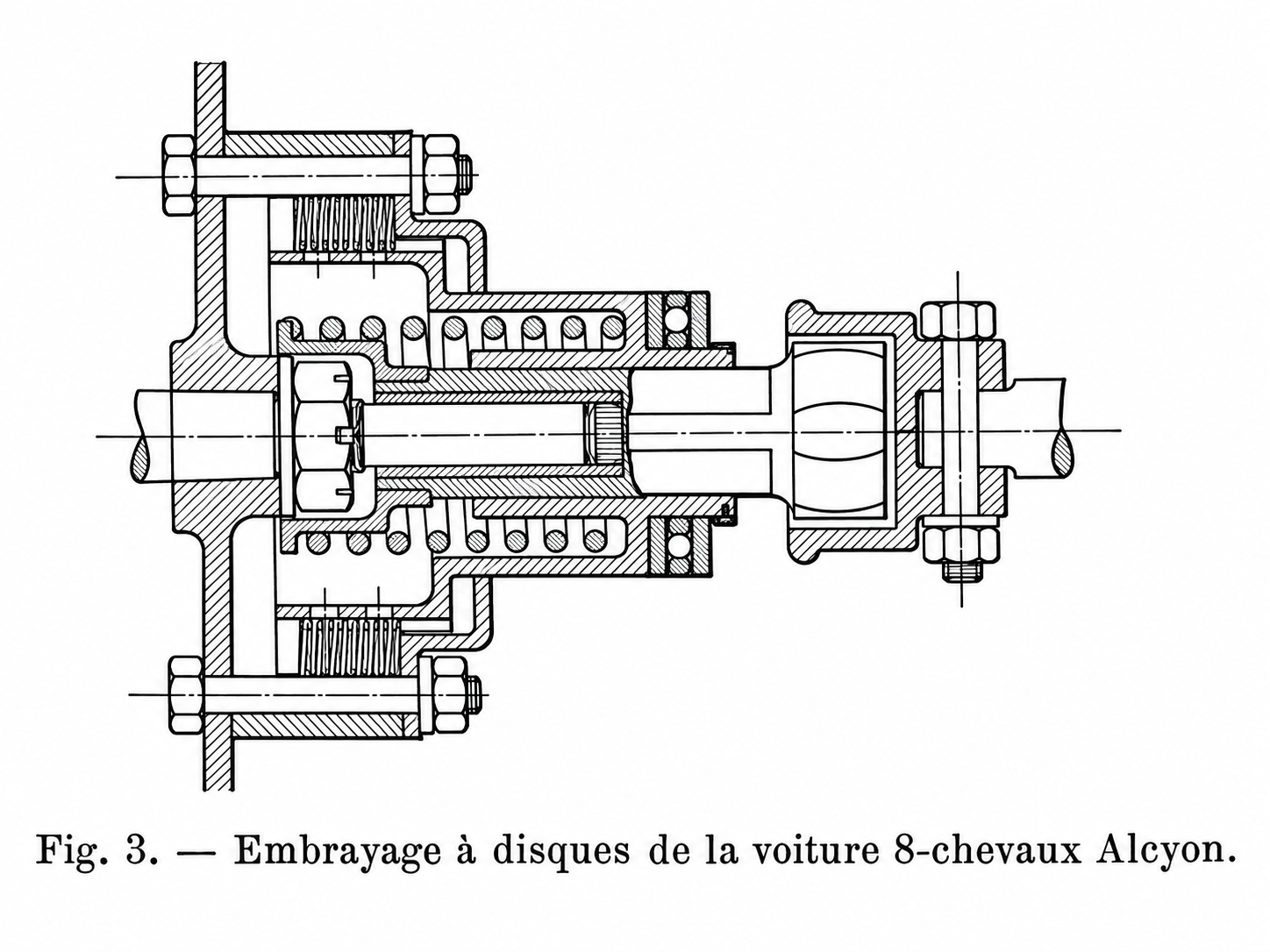
Although the engine was described as running smoothly, Alcyon adopted a disc-type clutch rather than the cone type common on other contemporary cars. Sainturat emphasised its progressive engagement and suitability for frequent manoeuvring or partial disengagement — especially important when controlling a large single-cylinder engine in town. The original article calls it an embrayage à disques; it does not establish the exact number of friction plates, so a precise multi-plate specification should not be assumed.
The gearbox had three forward ratios and reverse. The highest forward ratio was direct drive, while the selector mechanism was described as a conventional sliding-gear arrangement supported on ball bearings. The combination was notable not because it was radically unconventional, but because it gave a modest voiturette familiar full-sized-car operating characteristics.
A Pressed-Steel Chassis Designed for Economical Manufacture
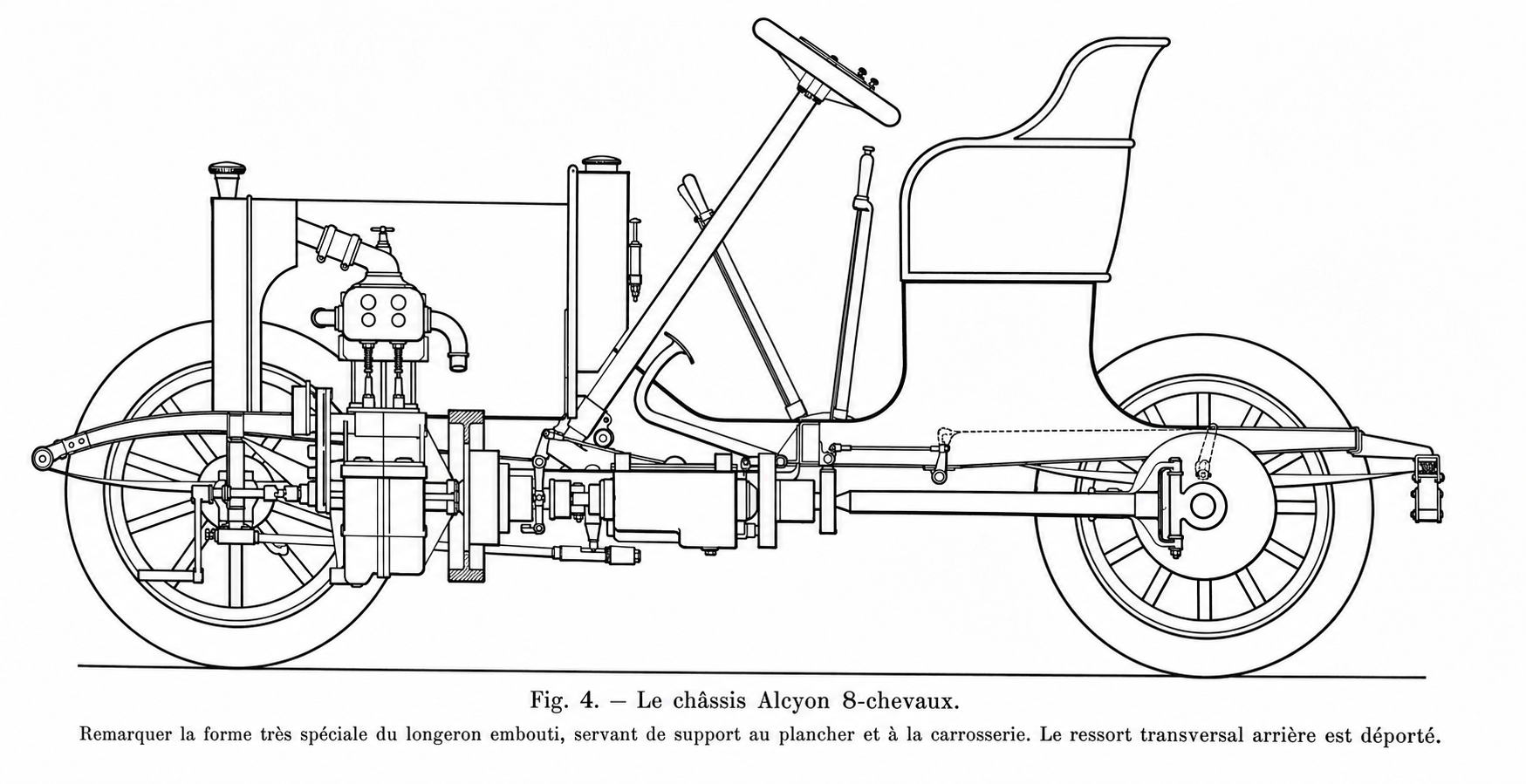
One of the most striking features described in the contemporary account was the use of pressed chassis members that also provided support for the floor and bodywork. Sainturat attributed the initiative to M. Surleau, identified in the article as an active director of the Alcyon company. By combining structural and body-support functions, the design reduced the number of separate manufacturing and assembly operations.
The period drawing shows the distinctive profile of the chassis member and a transversely mounted rear spring in an offset position. For the reviewer, this was not merely a matter of saving material: economies in chassis production could be redirected toward the gearbox, whose operating conditions were especially severe when driven by a large single-cylinder engine.
Shaft Drive and the Rear Axle
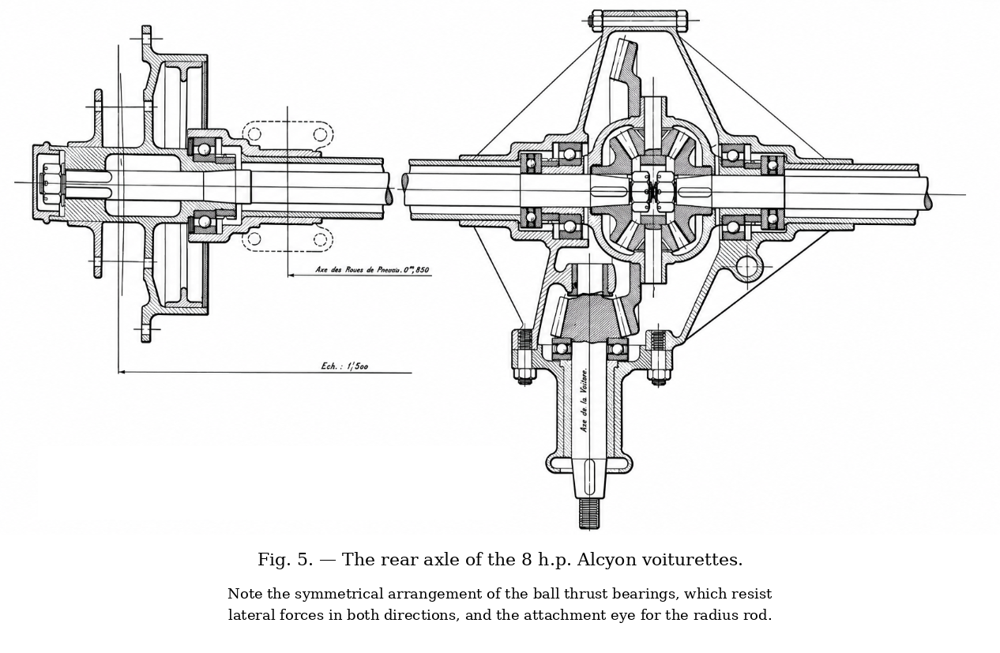
Power reached the rear axle through a shaft with two universal joints. The rear-axle assembly incorporated ball bearings and was designed to withstand forces arising from road irregularities, cornering and skidding. A torque-reaction attachment and articulated spring connections are visible in the period sectional drawing.
Particular attention was paid to the universal joints, which had bronze bearing blocks and protective leather gaiters. These gaiters shielded the joints against dirt and mud, a considerable benefit on the generally unsealed roads of the period. Sainturat pointedly observed that some rival makers left such protection to the discretion of the owner.
Technical Specifications Recorded in 1907
| Vehicle | Alcyon single-cylinder voiturette, rated 8 hp |
|---|---|
| Cylinder bore × stroke | 105 × 120 mm |
| Engine displacement | Approximately 1,039 cc (calculated from the period dimensions) |
| Valves | Side-mounted, mechanically operated; inlet and exhaust valves interchangeable |
| Crankcase / flywheels | Cast aluminium crankcase with two large flywheels |
| Cooling | Water cooling by thermosiphon |
| Lubrication | Manual plunger oiler and drip-feed device |
| Ignition | Battery and coil; optional high-tension magneto, dual ignition possible |
| Clutch | Progressively engaging disc type |
| Gearbox | Three forward speeds, top gear direct, plus reverse |
| Final drive | Shaft with two universal joints; rear axle on ball bearings |
| Chassis | Pressed structural members supporting the floor and body |
How to Read the 1907 Assessment
Sainturat’s account is a valuable contemporary technical source, but it is also enthusiastically favourable to the manufacturer. His assurance that the Alcyon would give faithful service is a period judgement, not evidence from long-term reliability testing. Equally, the article provides neither production totals nor independent measurements of speed, fuel consumption or vehicle weight.
It nevertheless establishes something more concrete than a general claim that Alcyon made small cars. The 1907 voiturette combined a single-cylinder engine with mechanically operated interchangeable side valves, unusually substantial flywheels, a progressive disc clutch, direct-drive top gear and a protected shaft-driven rear axle. The strategy was to contain manufacturing cost without reducing the vehicle to a motorised cycle.
One small editorial curiosity is worth noting. In the original French text the clutch is referred to as being illustrated in Figure 5; the printed captions identify Figure 3 as the clutch and Figure 5 as the rear axle. The present article follows the captions.
Primary Source
Maurice Sainturat, “La Voiturette Alcyon,” La Vie automobile, 1907, pp. 330–332. Digitised by the Conservatoire numérique des arts et métiers (Cnum), CNAM, Paris. Consult the original article (p. 330).