
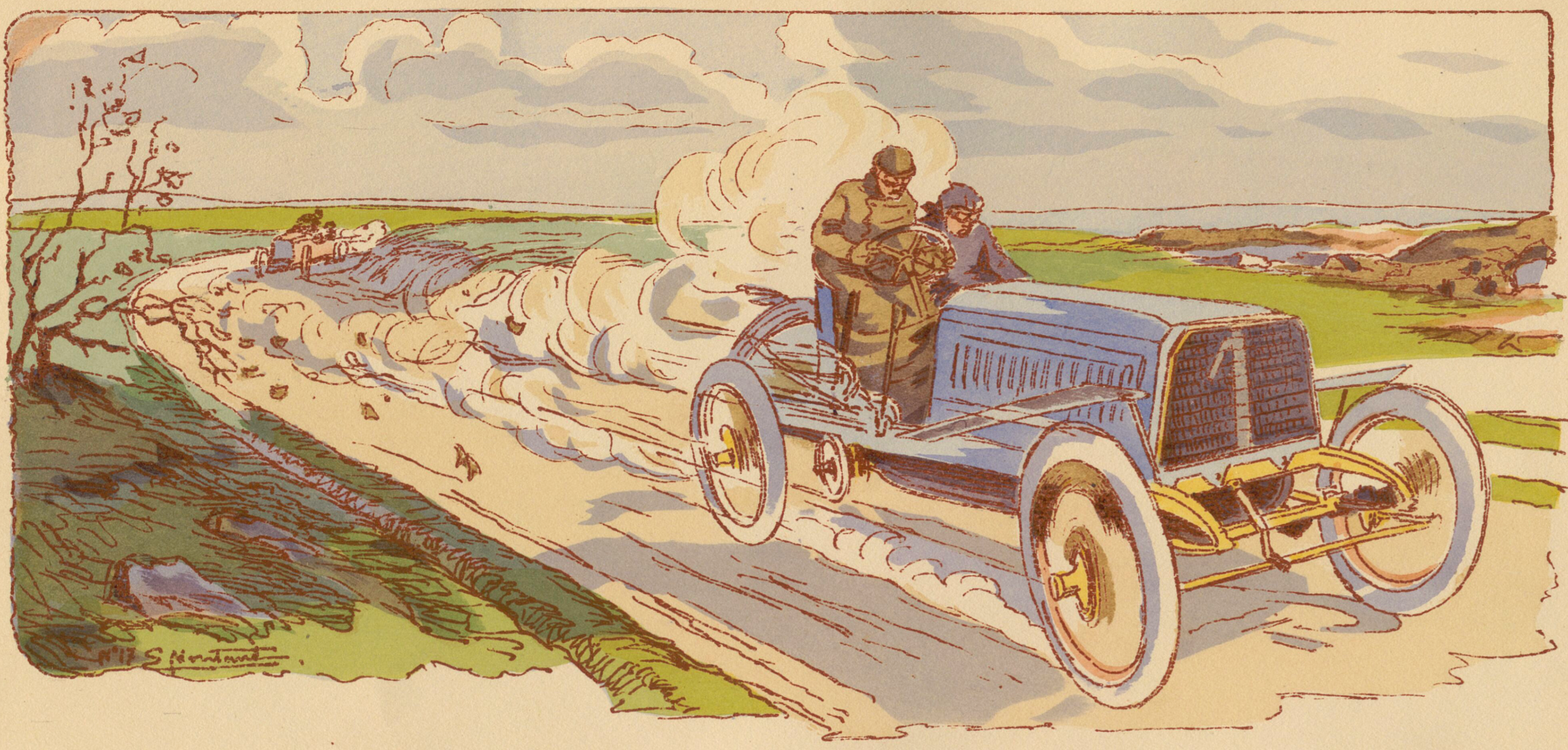
AUTOMOBILE RACES
From the First Trials to the Grand Prix (1894–1914)
The history of automobile racing is inseparable from the history of the automobile itself. At the end of the nineteenth century, when the motor car was still an unfamiliar and frequently mistrusted invention, public competitions offered a means of demonstrating its practical value. They showed that mechanically propelled vehicles could travel substantial distances, negotiate ordinary roads, and function without the assistance of horses. What began principally as a demonstration of mechanical transportation gradually developed into an international sport in which the performance of machines and the capabilities of manufacturers were subjected to public examination.
France occupied a central position in this transformation. Its road network, engineering traditions, sporting press, and growing automobile industry created favourable conditions for motor competitions. Manufacturers such as Panhard & Levassor, Peugeot, and De Dion-Bouton recognised that racing and public trials could promote confidence in their machines while exposing technical weaknesses. Competitions soon attracted interest from Germany, Italy, Great Britain, the United States, and other countries. Between 1894 and 1914, the purposes, rules, equipment, and organisation of motor racing changed profoundly.
From Practical Demonstrations to Sporting Competition
The first automobile contests did not necessarily define success by speed alone. Organisers and spectators wanted to know whether a mechanical carriage was safe, manageable, economical, and sufficiently reliable for ordinary use. At a time when competing forms of propulsion and vehicle construction remained under consideration, such trials offered a public test of the automobile as a practical proposition.
Events such as Paris–Rouen in 1894 and Paris–Bordeaux–Paris in 1895 marked successive stages in this change of outlook. They are important here not for their individual results, but because they illustrate the movement from assessing the usefulness of a vehicle toward assessing its speed, endurance, and mechanical dependability. As confidence in the automobile increased, competition became an end in itself rather than merely a demonstration of a new means of transport. The circumstances and results of individual events belong to the separate studies listed in the directory.
Automobile Clubs, the Press, and Sporting Organisation
Early motor racing developed through cooperation among manufacturers, journalists, enthusiasts, and organisers. Newspapers provided publicity, encouraged public interest, and helped create occasions on which different vehicles could be compared. The growing number and complexity of competitions, however, made permanent institutions increasingly necessary. The Automobile Club de France, founded in 1895, became especially influential in the organisation of early motoring and the development of sporting regulations.
Automobile clubs helped establish entry requirements, vehicle classifications, methods of timing, and the procedures through which results could be recognised. Their influence also extended to relations with public authorities, questions of road access, and the representation of national sporting interests. These institutions gradually transformed occasional demonstrations into a more organised system of competitions. At this stage, the separation between sport and industry remained limited: manufacturers, engineers, mechanics, and drivers often worked closely together, and the commercial importance of a race was inseparable from its sporting character.
The Era of City-to-City Racing
During the last years of the nineteenth century and the beginning of the twentieth, long-distance races between cities became a characteristic form of European automobile competition. Routes followed existing public roads, often over great distances and through widely varying conditions. Road surfaces, gradients, dust, weather, and the availability of assistance placed exceptional demands on both vehicles and their occupants. These competitions therefore tested more than maximum speed: they exposed the limits of mechanical endurance and the difficulties of maintaining reliable operation over prolonged journeys.
As engines became more powerful and the sporting emphasis shifted toward higher speeds, the limitations of open-road competition became increasingly apparent. Public highways were not designed for fast-moving racing cars; they also remained part of everyday life for pedestrians, animals, and ordinary traffic. The serious accidents associated with early racing, and particularly the crisis of 1903, forced organisers and authorities to reconsider how competitions could be conducted. The significance of this period lies in the transition it brought about, rather than in a sequence of individual victories.
Manufacturers, Engineering, and Technical Progress
For the emerging automobile industry, racing was both a form of public advertising and an unusually severe practical test. Manufacturers could demonstrate the capabilities of their machines to prospective customers, investors, and the press, while also learning how their designs behaved under demanding conditions. Competitive pressure encouraged more systematic preparation and closer attention to the relationship between the different parts of an automobile.
Higher engine output increased the importance of effective cooling, lubrication, fuel supply, and ignition. Sustained high-speed operation placed greater demands on transmissions, bearings, chassis strength, steering, suspension, and braking systems. Tyres had to withstand more severe loads and road conditions, making their construction and the methods used to repair or replace them increasingly important. The performance of the complete machine depended on the coordination of these systems rather than on a single impressive technical characteristic.
Competition also encouraged the organisation of technical support. Inspection, maintenance, fuel provision, tyre service, and repairs could determine whether an otherwise capable automobile completed a demanding event. Nevertheless, the relationship between racing and production must not be overstated. Not every successful racing solution was suitable for a touring car, and important innovations also arose independently of the sporting environment. The distinctive contribution of racing was to subject developing technologies to exceptional demands and to make their strengths and weaknesses publicly visible.
International Rivalry and National Prestige
Motor racing soon extended beyond the interests of individual manufacturers. Major international competitions encouraged automobile clubs and industrial communities to regard sporting performance as a reflection of national technical achievement. The Gordon Bennett Cup, introduced in 1900, was particularly important in establishing an international framework based on national representation. Rules limiting the number of entries per country illustrated both the possibilities and the difficulties of organising competition on that basis.
National racing colours, international publicity, and the increasing mobility of competitors strengthened the sense that automobile sport belonged to a wider industrial world. At the same time, the restrictive character of some international regulations caused disagreement, particularly in countries with many established manufacturers. Such tensions helped stimulate alternative sporting arrangements in which participation could be organised more directly around competing firms. The development of racing regulations was therefore influenced not only by questions of engineering and safety, but also by industrial interests and national prestige.
From Public Roads to Controlled Circuits and Grand Prix Racing
The rising speeds of racing cars made the use of uncontrolled public roads progressively more difficult. Organisers sought routes on which access could be restricted, spectators supervised more effectively, and the conduct of a competition governed by clearer procedures. Closed-road circuits represented an important development, although they should not be confused with the purpose-built, permanent racing facilities that emerged on a different timetable.
The establishment of the Grand Prix de l'Automobile Club de France in 1906 represented a further step toward a more distinct form of automobile sport. Defined entry requirements, technical regulations, and the preparation of specialised competition vehicles became increasingly important. The transition was gradual rather than absolute: different kinds of road racing and track competition continued to coexist, and improved organisation did not eliminate the dangers inherent in high-speed motoring. The individual Grand Prix events, their participants, and their results are subjects for separate articles.
The Expansion of Motor Racing Beyond Continental Europe
Although France was central to the earliest development of automobile racing, similar relationships between sport, technical progress, and commercial publicity arose elsewhere. In the United States, early public trials were followed by more ambitious road competitions and, eventually, major events held on dedicated racing facilities. American distances, road conditions, industrial organisation, and sporting preferences shaped a development that did not simply reproduce the European pattern.
Competitions associated with the Vanderbilt Cup and the emergence of racing at Indianapolis illustrated the widening geographical and organisational range of the sport. Elsewhere, British, German, and Italian events developed within their own technical and institutional settings. The resulting international diversity was one of the defining features of motor racing before the First World War. It also ensured that new methods of vehicle design, preparation, and organisation could attract attention beyond the country in which they first appeared.
A Specialised Sport on the Eve of the First World War
By the years immediately preceding 1914, racing had become a demanding branch of automobile engineering. Manufacturers devoted increasing resources to the design, preparation, and maintenance of cars intended specifically for competition. Technical rules governing such characteristics as weight, engine dimensions, or fuel consumption influenced the choices available to designers. Performance depended on a combination of mechanical efficiency, reliability, driver skill, and the organisation of the supporting team.
Racing cars were increasingly different from ordinary touring vehicles, although both remained connected through the industrial knowledge and manufacturing techniques on which they depended. The outbreak of the First World War interrupted this period of development. By then, however, motor racing had acquired recognisable sporting institutions, international traditions, specialised technical practices, and a public identity extending far beyond its origins as a demonstration of the horseless carriage.
The Historical Significance of Early Automobile Racing
The importance of early automobile racing cannot be measured solely through records, victories, or the reputations of individual drivers. Between 1894 and 1914 it helped change the way automobiles were tested, promoted, discussed, and understood. Public competitions contributed to confidence in mechanical road transport, encouraged rivalry among manufacturers, and exposed the relationship between increased performance and the need for improved organisation and safety.
Newspaper reports, technical journals, illustrations, and photographs carried the achievements and failures of early motor vehicles far beyond the roadside spectators. Racing became a means by which industrial development could be seen and debated in public. It also left historians a documentary record through which the evolution of automotive engineering, commercial competition, and sporting institutions can be studied.
This BrassCarEra section is intended as an introduction to that larger history. Its directory identifies important events, organisations, engineers, and drivers, including subjects for which individual studies are still in preparation. Separate articles will examine particular races in detail, using contemporary reports, technical descriptions, photographs, patents, and other original sources wherever possible. The purpose of the present overview is to explain the development of the sport as a whole, without anticipating the detailed findings of those future studies.
Sources and Further Reading
- Les Sports modernes, January 1901. L'Automobile: Les Grandes Épreuves. Contemporary retrospective on early racing.
- Automobile Club de France. Fondation de l'Automobile Club de France, 1895. Institutional background.
- Automobile Club de France. Compétition: La naissance du Grand Prix. Evolution of racing organisation.
- Gordon Bennett Cup Historical Archive. International racing regulations and background.
- Motor Sport. 1906 French Grand Prix. Background to Grand Prix competition.
- Vanderbilt Cup Races Historical Archive. American road-racing context.
- Indianapolis Motor Speedway. The Inaugural Indianapolis 500. Historical background to the American speedway tradition.
This directory includes both published articles and subjects planned for future research. Clickable entries lead to articles already available on BrassCarEra.