
Germany and the Birth of the Modern Automobile
German Engineering and the Internal Combustion Revolution, 1860–1914
The German Foundations of the Automobile Industry
The emergence of the modern automobile during the final decades of the nineteenth century was closely associated with the achievements of German engineers. Although France became the leading automobile-producing country of the pioneering era, the development of practical motor vehicles depended heavily upon advances in internal combustion engine technology made in Germany. The work of Nicolaus August Otto, Gottlieb Daimler, Wilhelm Maybach, and Carl Benz established the mechanical foundations upon which the European automobile industry was built. Their contributions were different but closely connected: Otto developed a commercially successful four-stroke engine, Daimler and Maybach created lightweight, high-speed engines suitable for transportation, and Benz demonstrated the possibilities of constructing an automobile as a complete mechanical system. Together, their achievements transformed the internal combustion engine from a stationary source of industrial power into the driving force behind a new form of transportation.
Nicolaus Otto and the Four-Stroke Engine
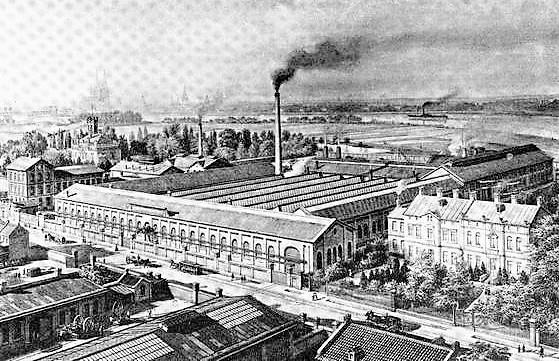
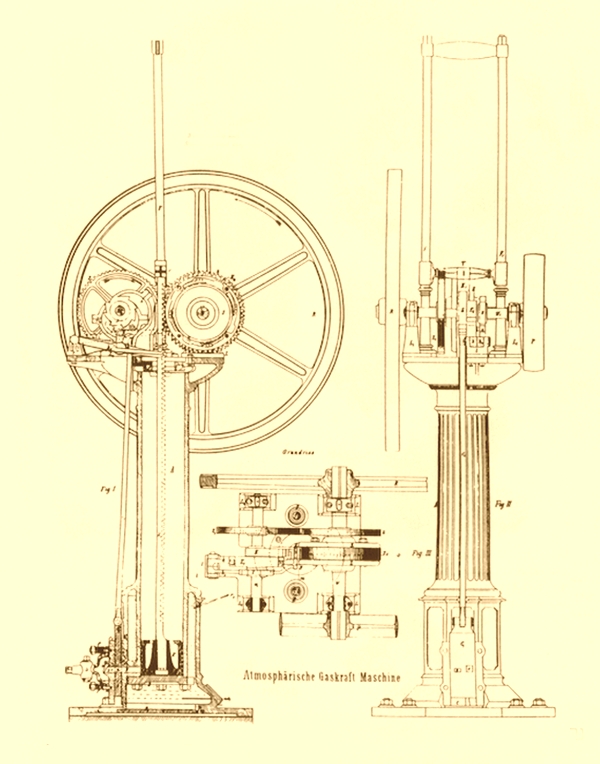
Nicolaus August Otto (1832–1891) played a fundamental role in the development of the practical internal combustion engine. In 1864, together with Eugen Langen, he established an enterprise devoted to the manufacture of gas engines, which subsequently developed into Gasmotoren-Fabrik Deutz. Following several years of experimentation, Otto successfully developed a four-stroke engine in 1876, operating through the familiar sequence of intake, compression, combustion and expansion, and exhaust. Although the theoretical principles of this cycle had previously been described by Alphonse Beau de Rochas, Otto's achievement lay in transforming them into a successful industrial machine. His engines were initially intended for stationary applications and remained too heavy and slow-running for practical road transportation. Nevertheless, the four-stroke principle provided the essential foundation for the development of the petrol automobile. Among the engineers who gained valuable experience at Deutz were Gottlieb Daimler and Wilhelm Maybach, whose subsequent work would extend the application of the internal combustion engine far beyond the factory workshop.
Gottlieb Daimler and Wilhelm Maybach
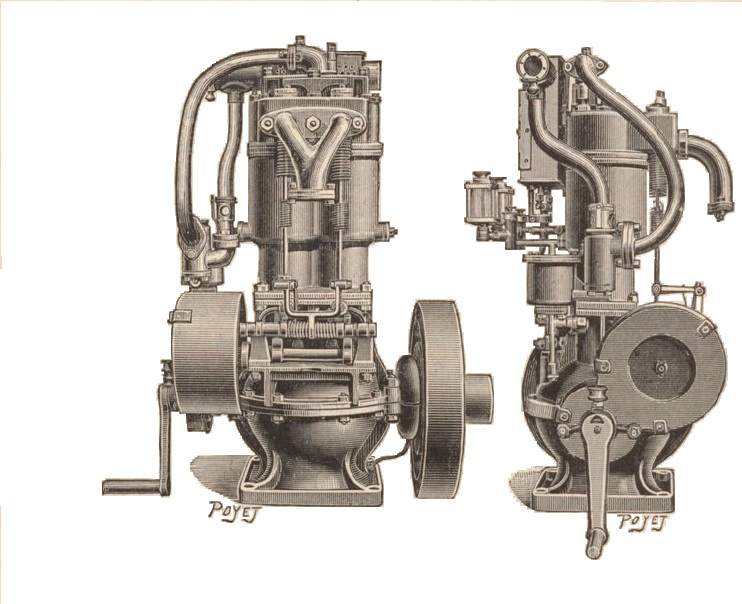
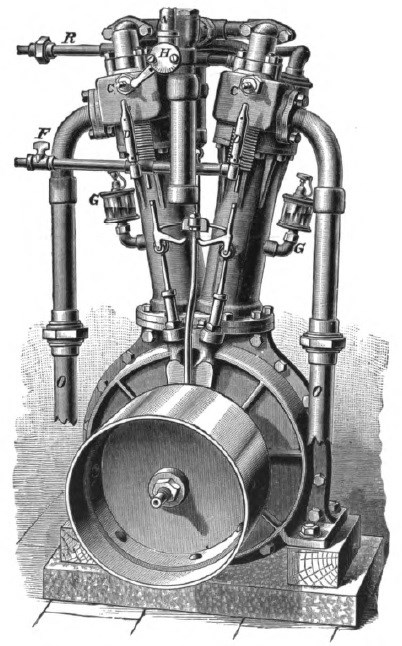
Gottlieb Daimler (1834–1900) and Wilhelm Maybach (1846–1929) recognized that the future of mechanical transportation depended upon the creation of a compact, lightweight engine capable of operating at considerably higher speeds than conventional stationary gas engines. After leaving Deutz in 1882, Daimler established an experimental workshop at Cannstatt, where Maybach joined him in developing a new generation of petrol engines. Their experiments resulted in the high-speed single-cylinder engine of 1885, popularly known as the Standuhr, or grandfather-clock engine. During the same year, they installed an engine in the experimental two-wheeled Reitwagen, followed in 1886 by the adaptation of a four-wheeled carriage to mechanical propulsion. These experiments demonstrated the practical possibilities of the lightweight internal combustion engine and marked an important stage in the development of motor transportation.
Maybach's engineering abilities were particularly important in the subsequent evolution of Daimler engines and automobiles. In 1889, Daimler and Maybach presented the Stahlradwagen at the Paris Universal Exposition, demonstrating a purpose-built motor vehicle powered by a compact two-cylinder V-engine. During the following decade, Maybach continued developing increasingly sophisticated engines and fuel systems, including improvements in carburetion that contributed to greater reliability and performance. The Phoenix engine family represented another important stage in this process. Daimler's mechanical concepts and Maybach's technical designs soon attracted attention beyond Germany, particularly in France, where their engines played a decisive role in the emergence of the pioneering automobile industry.
Carl Benz and the First Practical Automobiles
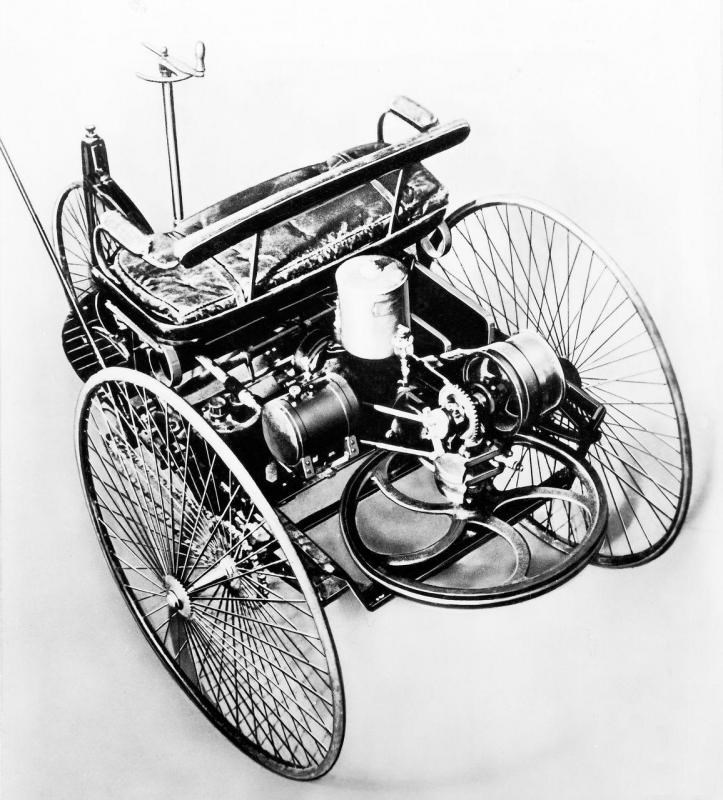
Working independently in Mannheim, Carl Benz (1844–1929) approached the problem of mechanical road transportation from a different direction. Rather than concentrating primarily upon the development of an engine suitable for various applications, Benz sought to create a complete vehicle in which the engine, chassis, transmission, and steering formed an integrated mechanical system. His three-wheeled Patent-Motorwagen, completed in 1885 and patented on 29 January 1886, represented one of the most important achievements of the pioneering automobile era. Powered by a horizontally mounted single-cylinder four-stroke engine, the vehicle demonstrated the feasibility of designing a machine specifically for mechanical road transport. The celebrated journey undertaken by Bertha Benz from Mannheim to Pforzheim in August 1888 further demonstrated the practical potential of the automobile, while drawing attention to the mechanical improvements still required.
Benz subsequently developed more advanced vehicles, including the four-wheeled Victoria of 1893 and the smaller Velo introduced in 1894. The latter became one of the earliest commercially successful production automobiles and helped establish Benz & Cie. as an important manufacturer. Although Benz and Daimler pursued their work independently, their achievements complemented one another and contributed to the emergence of a new industry.
German Engines and the Birth of the French Automobile Industry
The influence of German engineering upon the development of the French automobile industry was particularly significant. During the late 1880s, Édouard Sarazin established commercial connections with Gottlieb Daimler concerning the exploitation of his patents in France. Following Sarazin's death, his widow Louise continued these activities and worked closely with Émile Levassor, who recognized the potential of the lightweight petrol engine. The resulting arrangements enabled Panhard & Levassor to manufacture Daimler engines under licence, while Armand Peugeot also became involved in the development of petrol automobiles employing this technology. The Paris Universal Exposition of 1889 played an important role in bringing German engine technology to the attention of French industrialists and encouraging cooperation between the two countries.
Panhard & Levassor subsequently made a decisive contribution to the development of practical automobile construction. The company introduced and refined the mechanical arrangement that became widely known as the Système Panhard, with a front-mounted engine driving the rear wheels through a clutch, gearbox, and transmission. French engineers also developed their own improvements in steering, chassis construction, engines, and mechanical controls, transforming the early motor vehicle into an increasingly reliable and practical machine. The relationship between German engine designers and French automobile manufacturers was therefore one of technological cooperation and mutual development. Without the pioneering work of Daimler and Maybach, the emergence of the French petrol automobile industry would have been considerably more difficult, while Panhard & Levassor and Peugeot played essential roles in demonstrating the commercial possibilities of the new invention.
The Growth of the German Automobile Industry
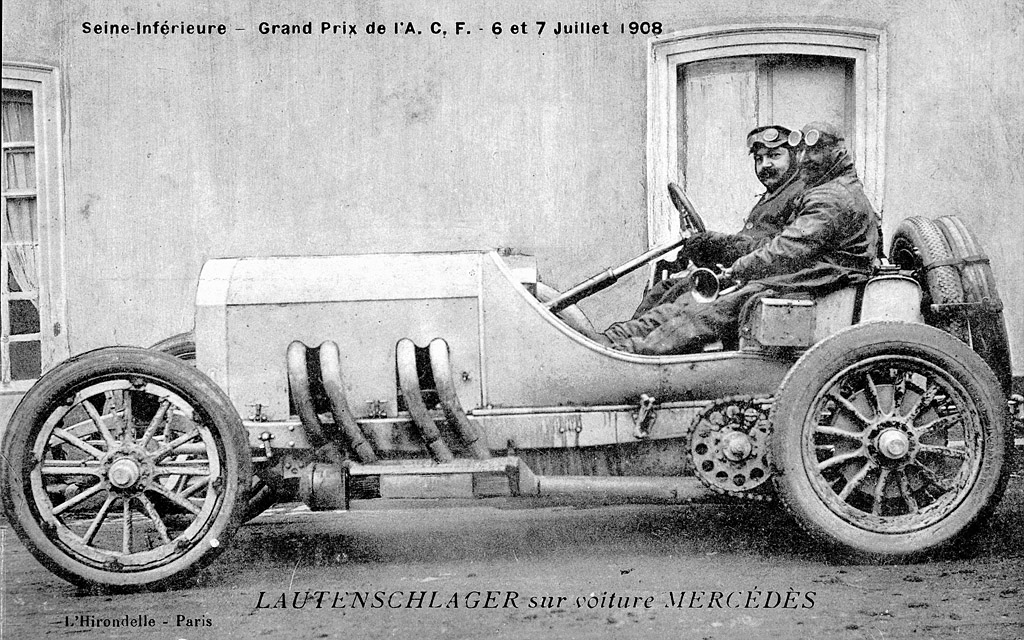
During the final years of the nineteenth century, automobile manufacturing gradually expanded throughout Germany. Daimler-Motoren-Gesellschaft and Benz & Cie. continued developing increasingly sophisticated vehicles, while other manufacturers, including Adler, Opel, Dürkopp, and Stoewer, entered the emerging industry. August Horch established his automobile enterprise in 1899, and the subsequent development of German manufacturing brought further companies into the market. A particularly important milestone was the Mercedes 35 HP of 1901, designed by Wilhelm Maybach, whose powerful engine, low chassis, long wheelbase, and improved cooling arrangements demonstrated the increasingly modern character of automobile engineering. German manufacturers also gained international recognition through motor racing, notably the victory of Christian Lautenschlager in a Mercedes at the French Grand Prix of 1908.
By the outbreak of the First World War in 1914, Germany possessed a well-established automobile industry capable of producing technically sophisticated passenger cars and commercial vehicles. The experimental engines and primitive motor carriages of the 1880s had evolved into reliable machines incorporating advanced mechanical systems, reflecting three decades of intensive engineering development. The contributions of Otto, Daimler, Maybach, and Benz remained fundamental to this transformation, while their influence extended far beyond Germany through the international exchange of technology and industrial experience. The automobile had become a truly European achievement, but the role of German engineers in creating its essential source of mechanical power was indispensable.