
AILLOUD ET DUMOND
From a bicycle workshop to a small automobile manufacturer, Ailloud et Dumond illustrates the experimental character of the French motor industry at the turn of the twentieth century. The Lyon firm never became a major producer, but it built its own cars, exhibited at one of the city's first motor shows and survived as a substantial automobile garage long after car manufacture had ended.
Claude Ailloud and the First Voiturette, 1897–1899
Claude Ailloud, also referred to as Claudius Ailloud in some later historical accounts, was a bicycle manufacturer based at 9 quai de la Mulatière in Lyon. Around 1897 he began work on a light motorcar, at a time when the automobile had yet to establish a standard mechanical layout.
The resulting two-seat voiturette reportedly weighed approximately 300 kg and employed a tubular chassis. Ailloud presented it at the first Lyon Salon du Cycle et de l'Automobile in December 1899, where it received a silver medal in the voiturette category. The award was recorded in the newspaper Lyon-Sport on 6 January 1900.
The engine of this first car remains a point of uncertainty. The Lyon historian Lucien Loreille described a single-cylinder, air-cooled engine, whereas another account identifies two vertical cylinders with a bore and stroke of 72 × 76 mm. The surviving exhibition award notice confirms Ailloud's recognition at the show but does not, by itself, settle the engine specification.
Nevertheless, his participation in the 1899 exhibition establishes that Ailloud had developed an automobile before entering into partnership with Francisque Dumond. The little voiturette belonged to the first generation of locally constructed motorcars that appeared in Lyon during the final years of the nineteenth century.
The Formation of Ailloud et Dumond
In 1900 Ailloud joined forces with Francisque Dumond. According to research published by the Lyon historical association Les 3A, the partnership was formed on 5 January 1900. The new business, generally recorded as Automobiles Ailloud et Dumond, established its workshop at 9 rue Duhamel in Lyon.
Contemporary and later publications sometimes give the partner's surname as Dumont. However, Dumond is the spelling found in Lyon historical records and on the firm's period garage imagery.
The partners set about producing small cars of their own design. By 1901 they had built a 5 hp voiturette powered by a front-mounted engine with two vertical cylinders and water cooling. This represented a more developed arrangement than that attributed to Ailloud's original experimental car.
Production was limited, although its exact scale remains uncertain. Lucien Loreille's historical account refers to five examples of the two-cylinder model, while The Beaulieu Encyclopedia of the Automobile, edited by George Nicholas Georgano, gives a figure of approximately twenty cars. The difference may reflect the scope of the vehicles being counted, but without contemporary production records the figures cannot be reconciled with certainty.
Other reference works distinguish two-cylinder engines of 1,004 and 1,105 cc. These figures have not yet been confirmed against contemporary factory documentation. Motor tricycles equipped with single-cylinder De Dion-Bouton engines are also mentioned in later accounts of the marque.
A Four-Cylinder Automobile
The firm's most ambitious project was a larger four-seat automobile with a four-cylinder engine developing approximately 14 hp, a four-speed gearbox and chain final drive. Compared with the small two-seat voiturettes, this represented a significant increase in size, power and mechanical complexity.
Some histories date the appearance of this model to 1902, while others associate the completed car with 1904. It appears to have remained a one-off rather than entering regular production.
The published technical figures are not entirely consistent. One account specifies a bore and stroke of 90 × 100 mm, corresponding to a calculated displacement of approximately 2,545 cc. Another gives 2,798 cc. Until a contemporary technical description is located, neither displacement should be treated as definitive.
According to a later encyclopedic account, the automobile was purchased by a Parisian customer and remained in use until 1914. If confirmed, this would indicate a relatively long service life for an experimental car produced by such a small manufacturer.
By 1904, Ailloud et Dumond had ceased building automobiles. The company, however, did not disappear.
The Garage on Rue Duhamel
The partners continued in the motor trade, selling, servicing and repairing cars manufactured by other companies. De Dietrich and Turcat-Méry were among the makes associated with the establishment. Grégoire and Mors are also mentioned in later reference works.
A report published in Lyon-Sport on 4 February 1905 identified Ailloud et Dumond Frères as the Lyon representatives of De Dietrich. It also reported that the firm was exhibiting the new 1905 model at its garage on rue Duhamel. This contemporary evidence demonstrates that the transition from manufacturing to automobile sales had already taken place shortly after 1904.
The business expanded beyond its original workshop. From 1910, commercial directories listed the establishment at 7 and 9 rue Duhamel. The spacious premises reflected the growing importance of automobile sales and maintenance in the rapidly developing motor industry.
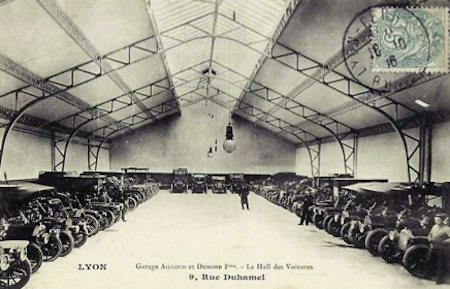
The historical postcard showing the Hall des Voitures, with automobiles lined up along both sides of the building, conveys the scale of the firm's later commercial operations. The photograph documents the premises as a dealership and garage rather than necessarily depicting the earlier manufacturing workshop. Its large covered hall accommodated numerous automobiles, illustrating the transformation of a small manufacturing enterprise into a substantial motor-trade establishment.
From 1920 the business was known as Dumond Frères Automobile. Its premises continued to serve Lyon's motoring public through subsequent decades. Between 1945 and 1950 a new garage and parking building was constructed at 7 rue Duhamel. In the 1960s the firm operated as a Peugeot agent, while regional industrial-heritage records later documented the property in connection with its use as a Renault garage.
Thus, the small workshop originally established to manufacture automobiles continued to exist as a commercial automotive enterprise long after its own vehicles had disappeared from production.
A Surviving Ailloud et Dumond in Andorra
One automobile bearing the Ailloud et Dumond name has survived and is displayed at the Museu Nacional de l'Automòbil in Encamp, Andorra.
Identified as a Type N2 dating from 1900, it has a vis-à-vis body, with passengers seated facing one another. Museum-related descriptions identify its power unit as a single-cylinder De Dion-Bouton engine developing approximately 2½ hp.
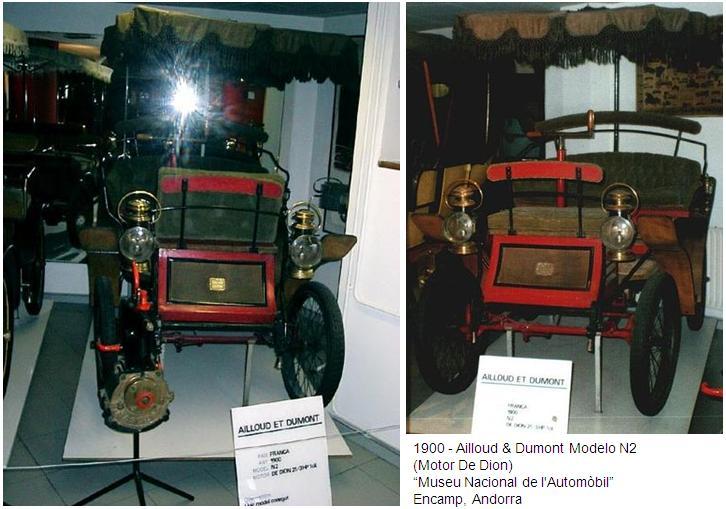
The surviving automobile is a rare physical witness to the earliest years of the marque. Its specification, however, differs substantially from that of the later 5 hp two-cylinder model described in historical reference works. It should therefore not be treated as an example of that particular series without additional evidence.
The preservation of this small French automobile is especially significant considering the limited production and short manufacturing history of Ailloud et Dumond. While numerous early automobile manufacturers disappeared without leaving surviving examples of their products, this vehicle provides a tangible link to the pioneering activities of the Lyon workshop.
Ailloud et Dumond in the History of the French Automobile
Ailloud et Dumond belonged to the numerous small enterprises that emerged as bicycle manufacturing, precision engineering and automobile construction began to overlap during the final years of the nineteenth century. Their activities reflected a period when automobile design had not yet become standardised and individual mechanics could experiment with different engine layouts, chassis arrangements and methods of power transmission.
Its history is not one of large-scale production. Rather, it illustrates the initiative of local mechanics and entrepreneurs who attempted to establish themselves in a rapidly developing industry, often with limited financial and manufacturing resources.
In Lyon, larger manufacturers such as Berliet, Rochet-Schneider, La Buire, Luc Court and Pilain gradually established stronger positions in the automobile market. Small independent constructors increasingly faced difficulties competing with these better-equipped enterprises.
For Ailloud and Dumond, the transition from manufacturing automobiles to selling and servicing vehicles from other makers provided an alternative path. Their garage remained active for decades, long outlasting the original automobile marque.
The surviving traces of Ailloud et Dumond are modest: an exhibition award recorded in the contemporary press, a handful of technical descriptions, historical images of its Lyon premises and a preserved automobile in Andorra.
Taken together, these sources offer a glimpse into the extraordinary diversity of the early French automobile industry, when even small workshops could contribute to the development of motor transport. Ailloud et Dumond represents one of the many forgotten enterprises whose histories help explain the formative years of the automobile in France.
Historical Sources
- Lyon-Sport, No. 105, 6 January 1900. Contemporary record of the silver medal awarded to Ailloud at the Lyon automobile exhibition.
- Lyon-Sport, 4 February 1905. Contemporary report on Ailloud et Dumond as representatives of De Dietrich in Lyon.
- Lucien Loreille, Constructeurs lyonnais d'automobiles, des origines à nos jours, Le Carnet de l'Automobile, 1968–1970, p. 32.
- George Nicholas Georgano, ed., The Beaulieu Encyclopedia of the Automobile, Vol. 1: A–F, Fitzroy Dearborn Publishers, 2001.
- Harald H. Linz and Halwart Schrader, Die Internationale Automobil-Enzyklopädie, United Soft Media Verlag, Munich, 2008.
- Les 3A-Historique, Constructeurs autos de A à D, historical research based on the work of Lucien Loreille.
- L'Automobile Ancienne, Ailloud et Dumond, historical article, 2019.
- Rue Duhamel, historical information concerning the Ailloud et Dumond garage, including references to the regional industrial-heritage inventory.
- Archives municipales de Lyon, historic postcard of the Ailloud et Dumond garage.
- Wikimedia Commons, Ailloud et Dumond automobile photographed at the National Automobile Museum of Andorra, Buch-t, 2003.
