
FIAT: From a Turin Workshop to an Automobile Manufacturer, 1899–1906
At the end of the nineteenth century, when the automobile was beginning to emerge as a practical means of transport, Italy occupied a relatively modest position in the development of the new industry. France and Germany had already established important centres of automobile manufacture, while Italian production remained largely confined to individual inventors, mechanics and small workshops. Yet northern Italy possessed many of the industrial resources necessary for the development of motor vehicles: established mechanical workshops, skilled metalworkers, engineering traditions and a growing class of entrepreneurs interested in new technologies. Turin, in particular, was well placed to become a centre of automobile construction. It was here, in 1899, that the Fabbrica Italiana di Automobili Torino, soon universally known by its initials FIAT, was established. Within a remarkably short period, the company would progress from producing a small automobile derived from an existing workshop design to manufacturing sophisticated touring cars and powerful engines capable of attracting international attention.
The Origins of FIAT and the Birth of the Italian Automobile Industry
The origins of FIAT were closely connected with Giovanni Battista Ceirano, a Turin mechanic who had previously been engaged in the bicycle trade. His workshop, operating under the name Ceirano & C., developed an automobile called the Welleyes, designed by the engineer Aristide Faccioli. Completed in 1899, the vehicle was a small petrol-engined carriage with a two-cylinder engine. Its importance was not simply technical: it demonstrated that an Italian workshop could produce a motor vehicle sufficiently promising to justify further investment. Among those who recognised this opportunity were Emanuele Cacherano di Bricherasio and Cesare Goria Gatti, who helped bring together the financial and industrial interests required to transform a small experimental enterprise into a properly organised manufacturing company. The foundations of FIAT were therefore laid through a combination of mechanical expertise, entrepreneurial initiative and the resources of Turin’s established business community.
On 11 July 1899, the new company was formally constituted in Turin with an initial capital of 800,000 lire, divided into 4,000 shares. Its founding group included representatives of the Piedmontese aristocracy, banking, commerce and industry. Ludovico Scarfiotti became the company’s first president, while Emanuele Cacherano di Bricherasio served as vice-president. Another participant was Giovanni Agnelli, a former cavalry officer whose determination and organisational ability would gradually make him the dominant figure in the enterprise. Although later histories frequently present Agnelli as the sole founder of FIAT, the original organisation was the collective undertaking of several investors and promoters. The company’s subsequent development would demonstrate the significance of Agnelli’s leadership, but its establishment cannot be separated from the work of Ceirano, Faccioli and the other individuals who contributed to its beginnings.
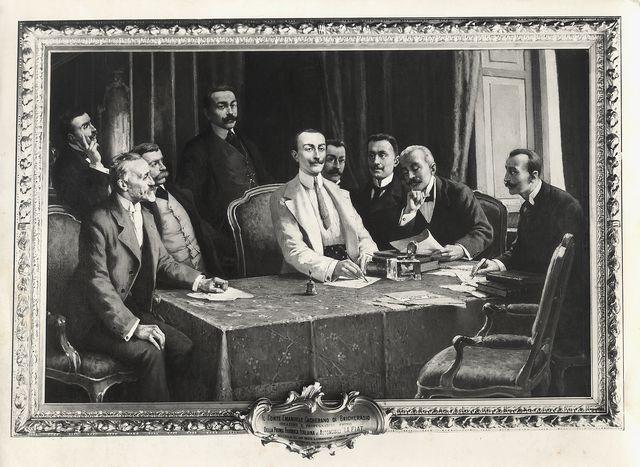
The scene of the company’s foundation was commemorated several years later in a painting by Lorenzo Delleani, commissioned by FIAT in 1906. Entitled I Fondatori della FIAT, the painting portrays the original founders gathered around the table at which the company’s establishment was formalised. Although produced retrospectively, the work remains an important historical representation of the personalities who participated in the creation of the enterprise. It also reminds us that FIAT originated not as the undertaking of a single inventor, but as a collective industrial venture supported by several prominent figures in Turin society.
Shortly after its formation, FIAT acquired the automobile activities of Ceirano & C., including the rights and technical resources associated with the Welleyes. This provided the new manufacturer with something particularly valuable: an existing vehicle design that could enter production without the lengthy experimental work normally required to develop a completely new automobile. The first FIAT, known as the 3½ HP, was consequently derived directly from Faccioli’s Welleyes. The transition from Ceirano to FIAT represents one of the most interesting episodes in the formation of the Italian automobile industry, illustrating how the experience accumulated in a small mechanical workshop could become the foundation of a much larger industrial enterprise.
The First FIAT Automobile
The FIAT 3½ HP retained the general mechanical arrangement of its predecessor. Its two-cylinder horizontal engine was mounted at the rear of the vehicle, driving the rear wheels through a chain transmission. The water-cooled engine had a displacement of approximately 679 cm³, while the transmission provided three forward speeds but no reverse gear. With a maximum speed of roughly 35 km/h, the little automobile belonged to the earliest generation of Italian petrol-driven vehicles, when mechanical simplicity, low weight and the ability to function reliably were more important than comfort or high performance. According to the Museo Nazionale dell’Automobile in Turin, thirty examples were constructed in 1899–1900, representing a decisive step from experimental engineering towards organised automobile manufacture.
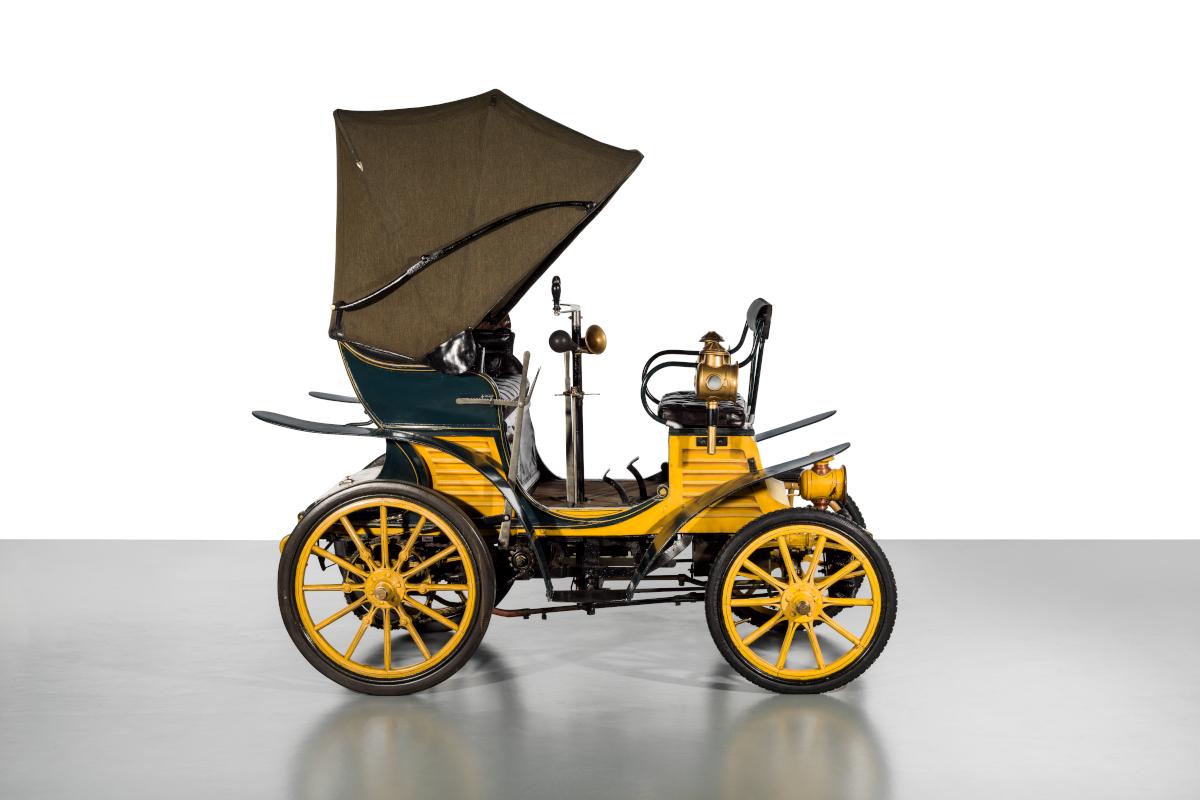
The mechanical arrangement of this early vehicle illustrates the transitional character of automobile design at the close of the nineteenth century. Its rear-mounted engine, compact dimensions and carriage-like bodywork still reflected the experimental origins of the motor car. Within only a few years, however, the increasing power and weight of automobiles would encourage manufacturers to adopt more substantial chassis and the front-engine arrangement that was rapidly becoming the standard for larger touring vehicles. FIAT participated in this evolution from the beginning, abandoning the limitations of its first small model as it developed vehicles suited to longer journeys, greater loads and more demanding customers.
The Factory at Corso Dante and the First Years of Production
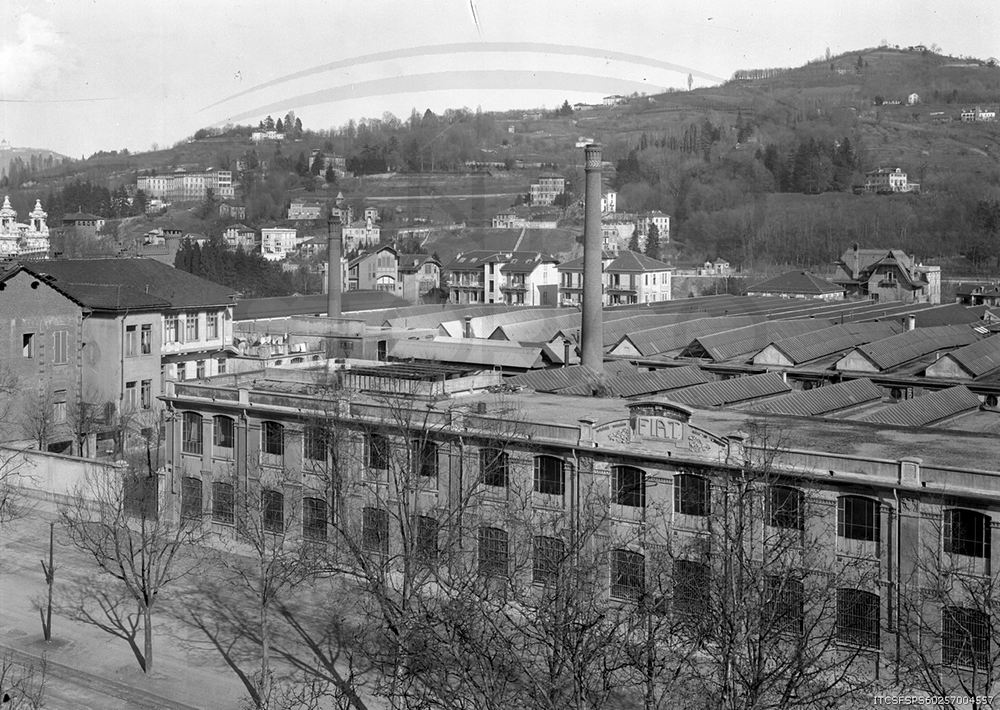
FIAT’s first purpose-built factory was inaugurated in March 1900 at Corso Dante in Turin. The establishment of a dedicated manufacturing plant represented an important departure from the workshop-based methods characteristic of many early Italian automobile constructors. It allowed production to be organised around the particular requirements of motor vehicles, with specialised equipment, manufacturing operations and the possibility of gradually expanding output. FIAT did not immediately become a mass producer in the modern sense, but its founders had established an industrial framework capable of supporting considerably greater ambitions.
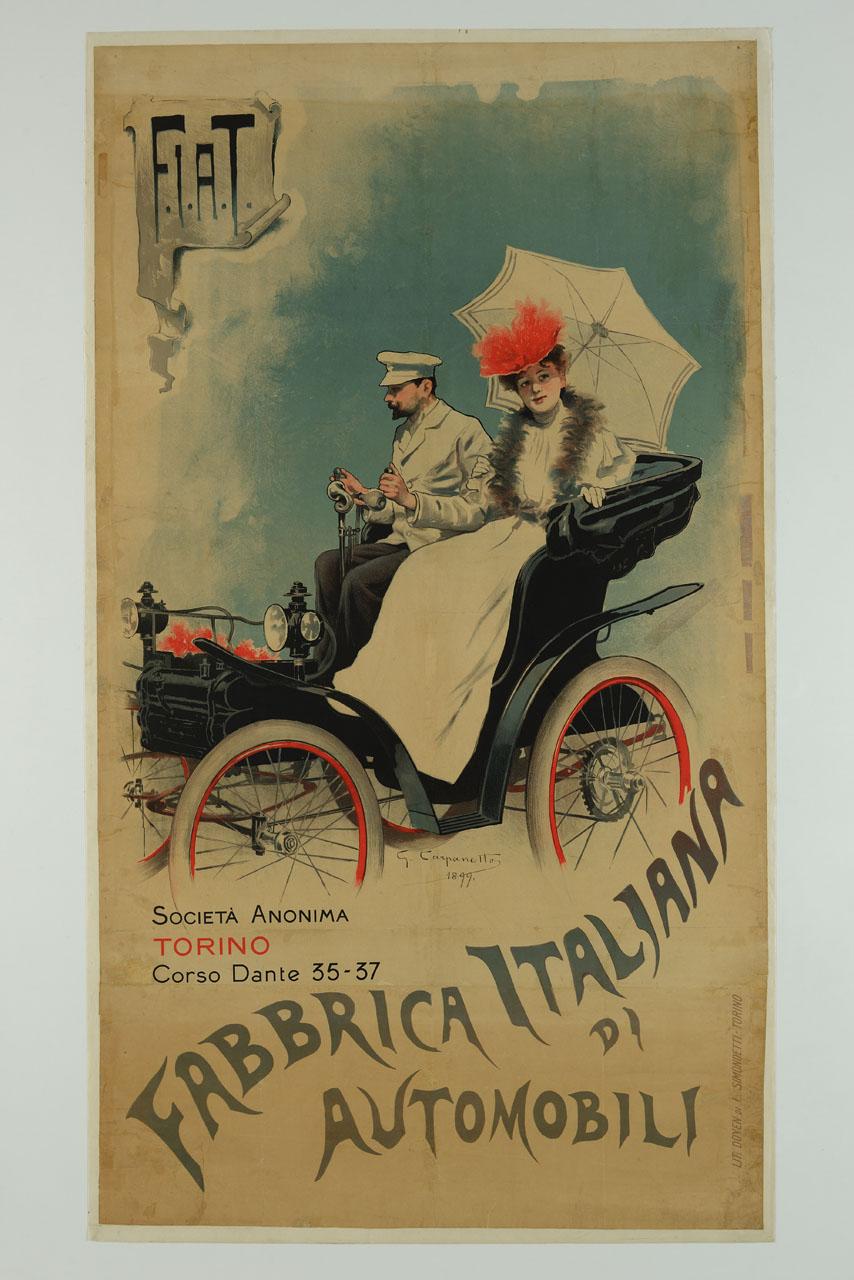
The company also understood that manufacturing automobiles was only part of the challenge. The public had to be persuaded that a petrol-engined vehicle was a useful and desirable alternative to horse-drawn transport. One of the earliest surviving examples of this approach is the FIAT advertising poster designed by Giovanni Battista Carpanetto in 1899. It presented the automobile not as an experimental machine, but as an elegant possession suitable for fashionable society. This image reflected the market conditions of the period, when the automobile remained an expensive product intended primarily for prosperous private buyers. At the same time, its association with modern engineering and personal independence helped establish the motor car as a symbol of technological progress.
As production developed, FIAT moved beyond the small rear-engined vehicle inherited from Ceirano. New models employed larger engines and more substantial chassis, reflecting the rapid technical changes then transforming European automobile construction. The development of four-cylinder engines was especially significant, allowing manufacturers to increase power while improving the regularity of engine operation. The front-engined touring car, with its engine mounted beneath a bonnet and its power transmitted to the rear wheels, was becoming the preferred arrangement for larger vehicles. FIAT’s early development followed this broader evolution while progressively introducing its own engineering solutions.
The Development of the FIAT Range, 1901–1903
By 1902, FIAT was advertising a range that demonstrated how far the company had progressed beyond its first small automobile. An original announcement published in the Italian journal La Stampa Sportiva, headed “Automobili FIAT — Modello 1902,” described chassis intended to receive different forms of coachwork. The frame was constructed of wood reinforced by metal members, while the axles and springs were presented as particularly robust. The advertisement specified wheels fitted with pneumatic tyres and a gearbox providing three forward speeds through gears remaining in constant mesh. Steering, braking and general ease of operation were emphasised as important qualities of the new design.
According to the same contemporary advertisement, the 1902 range included an 8-horsepower model with a two-cylinder engine and larger 12- and 24-horsepower models with four cylinders. The engines employed electromagnetic ignition and water cooling, with a pump and fan to assist circulation. FIAT also stressed smooth running, reliability and economical operation. These claims naturally reflected the manufacturer’s commercial interests, but they provide valuable evidence of the qualities that FIAT considered most important to prospective purchasers. By this time the company was no longer presenting a single experimental automobile; it was offering vehicles of different powers and intended uses, supported by a growing manufacturing organisation.
The 1902 advertisement is also revealing from a constructional standpoint. Its description of a wooden chassis reinforced with metal components belongs to a transitional period when European manufacturers had not yet universally adopted pressed-steel frames. The requirements of increasing engine power, heavier coachwork and higher road speeds were encouraging changes in chassis construction, but traditional materials and methods remained in use alongside newer solutions. The development of FIAT during these years therefore provides an instructive example of the rapid evolution of automobile engineering, in which established carriage-building practices were gradually giving way to designs conceived specifically for motor vehicles.
An illustrated report published in La Stampa Sportiva on 22 June 1902 provides additional evidence of FIAT’s rapidly increasing technical and commercial ambitions. At the automobile and cycle exhibition, the company displayed several engines of 8, 12 and 24 horsepower, a complete 8-horsepower chassis, a 24-horsepower racing vehicle and a 12-horsepower touring car. The journalist drew attention to the manufacturer’s patented mechanical coupling, constant-mesh gearbox, electromagnetic ignition and cooling arrangement. The report is particularly significant because it documents the company’s products as they were publicly exhibited and described at the time, rather than through the retrospective classifications commonly encountered in later automobile histories.
The importance of these developments extended beyond the domestic Italian market. FIAT increasingly participated in international exhibitions and sought to establish a reputation abroad. Motor competitions and long-distance journeys also became valuable means of demonstrating performance and reliability. For a relatively young Italian company competing against manufacturers with greater experience, successful participation in such events could provide recognition that conventional advertising alone could not achieve. Giovanni Agnelli, who became managing director in 1902, recognised the commercial possibilities of these activities and encouraged the development of the company beyond its initial regional market.
Engineering Development and International Recognition, 1904–1906
By the middle of the decade, FIAT had acquired a position that would have seemed remarkable only a few years earlier. Its larger touring cars were becoming known outside Italy, and foreign technical journals were beginning to examine the company’s engineering achievements. An illustration published in the British Automotor Journal on 29 July 1905 showed the arrival of a new 60-horsepower FIAT in England. Such a vehicle demonstrated the manufacturer’s growing ability to construct powerful automobiles intended for a market that increasingly demanded speed, endurance and mechanical refinement. The comparison between these substantial touring chassis and the company’s first small rear-engined vehicle reveals the extraordinary pace of its development.
A particularly detailed contemporary account of the company’s technical progress appeared in Henri Mortimer-Mégret’s Les perfectionnements automobiles en 1906, a survey of improvements displayed by automobile manufacturers at the Paris Salon of December 1905. The author devoted several pages to FIAT and expressed considerable admiration for the rapid progress of the Italian automobile industry. He regarded the Turin manufacturer as one of the principal contributors to that development, drawing attention not only to the robust construction and harmonious appearance of its chassis, but also to a series of original mechanical arrangements.
The four-cylinder FIAT engines described by Mortimer-Mégret employed cylinders cast in pairs, with the cylinder heads integral with the castings. Removable pressed-steel covers provided access to the water jackets, facilitating inspection and the removal of deposits from the cooling passages. Particular attention was devoted to reducing mechanical noise, an increasingly important quality as automobiles became more refined and their owners more demanding. The crankshaft was supported by five main bearings, while the ignition system employed a low-tension magneto. These details illustrate the considerable attention being devoted to reliable operation, accessibility and mechanical precision.
One of the most unusual features of the FIAT engine was its lubrication system. Instead of relying solely on conventional mechanical oil pumps, the design described in 1906 employed eight small endless chains that dipped into the oil and carried it upwards to distributing funnels. From these funnels, separate pipes conveyed the lubricant to the various bearings and other components requiring lubrication. The chains were driven continuously by the engine through a belt-and-pulley arrangement. This ingenious device, compared by Mortimer-Mégret to the principle of a chain pump, illustrates the variety of solutions explored by manufacturers before pressure lubrication systems became more widely standardised. It also demonstrates why detailed contemporary technical publications are so valuable: mechanisms of this kind are easily overlooked in general histories devoted primarily to complete automobiles and their external appearance.
The transmission and chassis arrangements were similarly sophisticated. FIAT employed a multiple-plate clutch operating in an oil bath, using the compression of alternating plates to transmit engine torque and their separation to disengage the transmission. The cooling system incorporated a honeycomb radiator assisted by a fan and water pump, while the radiator mounting was designed to accommodate movement and distortion of the chassis without imposing damaging stresses on the radiator itself. The substantial chassis combined the strength required by increasingly powerful engines with the flexibility necessary for operation on the uneven roads of the period. These details reveal an approach increasingly concerned with the automobile as a complete mechanical system, rather than a collection of individual devices.
By 1906, FIAT’s activities were no longer confined to private passenger automobiles. Contemporary technical literature also referred to its omnibuses, commercial vehicles and motorboat engines. Mortimer-Mégret recorded the company’s factory at 35 Corso Dante, Turin, and a French establishment at 7–9 Route de la Révolte, Levallois-Perret, providing tangible evidence of its presence beyond Italy. The transformation was striking. In little more than six years, an enterprise that had begun with the acquisition of a small workshop’s automobile design had become an internationally recognised manufacturer capable of producing powerful engines, substantial touring chassis and vehicles intended for several different branches of motor transport.
FIAT and the Emergence of Modern Italian Automobile Manufacturing
The early history of FIAT is inseparable from the broader transformation of Italian industry at the turn of the twentieth century. Its development combined the ingenuity of individual engineers with the financial resources and organisational capabilities of a new industrial enterprise. Giovanni Battista Ceirano and Aristide Faccioli provided the mechanical foundation; the original group of investors supplied the capital and institutional framework; and Giovanni Agnelli increasingly directed the company towards expansion, technical improvement and international markets. FIAT’s significance lay not in the invention of an entirely new principle of automobile construction, but in its ability to absorb, develop and industrialise the technologies that were transforming road transport throughout Europe.
Between 1899 and 1906, the company progressed from a modest rear-engined two-cylinder vehicle to a range of sophisticated touring automobiles equipped with powerful engines, advanced lubrication arrangements, carefully designed transmissions and substantial chassis. This evolution reflected the remarkable pace of automobile engineering during the period, but it also revealed the emergence of an Italian manufacturer capable of competing with established foreign companies. FIAT would subsequently grow into one of Europe’s most important industrial enterprises, yet many of the characteristics that made its expansion possible were already visible during these formative years: the combination of engineering expertise, organised production, technical adaptability and a determined pursuit of international recognition.
The surviving contemporary advertisements, technical descriptions, factory records and journal illustrations offer an exceptionally revealing picture of this early development. They show that the history of FIAT was never simply the story of one celebrated industrialist or a succession of increasingly powerful automobiles. It was also the history of the mechanics, designers, entrepreneurs and workers who helped establish automobile manufacturing in Turin and contributed to the emergence of Italy as an important centre of the international motor industry.
Historical Sources
1. I primi quindici anni della FIAT. Verbali dei consigli di amministrazione, 1899–1915. Archivio Storico Fiat, Milan, 1987. Published collection of the company’s original board minutes documenting its establishment, administration and industrial development.
2. La Stampa Sportiva, 1902. Contemporary FIAT factory advertisement, “Automobili FIAT — Modello 1902,” describing engines, chassis, ignition and transmission.
Digitised original.
3. La Stampa Sportiva, 22 June 1902. Illustrated report on the Fabbrica Italiana d’Automobili di Torino and its exhibits at the automobile and cycle exhibition.
Digitised original.
4. The Automotor Journal, 29 July 1905, p. 945. Contemporary description and photograph of a 60-hp FIAT chassis imported into England.
Digitised original.
5. Henri Mortimer-Mégret, Les perfectionnements automobiles en 1906, Paris, 1906, pp. 99–103. Technical study of FIAT engines, lubrication, ignition, clutch, cooling and chassis construction.
Digitised original, CNAM.
6. Giovanni Battista Carpanetto, FIAT advertising poster, 1899. Historical advertising material documented in the collections of the Museo Nazionale dell’Automobile, Turin.
Historical collection.
7. Lorenzo Delleani, I Fondatori della Fiat, 1906. Painting commissioned by FIAT, representing the company’s founders at the meeting of 11 July 1899.
Centro Storico Fiat.
8. Museo Nazionale dell’Automobile, Turin. Historical and technical documentation concerning the FIAT 3½ HP of 1899.
MAUTO collection.