
AUDIBERT & LAVIROTTE (1894–1901)
Among the pioneers of the French automobile industry, Maurice Audibert and Émile Lavirotte occupy a distinctive place. Their enterprise, established in the Monplaisir district of Lyon during the mid-1890s, was among the first automobile manufacturers in a city that would subsequently become an important centre of French motor-vehicle production. Although their partnership lasted only a few years, it encompassed a remarkable period of experimentation, during which the automobile evolved from a modified horseless carriage into a machine with increasingly distinctive engineering principles. Contemporary French and American automobile journals document that change with unusual precision, while surviving photographs of the Monplaisir works show the industrial setting in which the cars were built.
The Founders and Their First Experiments

Maurice Audibert (1867–1931) came from a family engaged in Lyon's silk trade and received his engineering education at the École centrale de Lyon. His future associate, Émile Lavirotte (1870–1944), was the son of a notary. The two men had known one another since their school years, but their decision to enter the emerging automobile industry represented a departure from the commercial traditions of their families. Lyon already possessed a strong industrial infrastructure and many skilled mechanics, yet the manufacture of petrol-driven road vehicles remained an experimental undertaking.
According to a story preserved by automobile historian James M. Laux, Lavirotte's interest in motor vehicles was awakened during his military service in Grenoble in 1892. Already experimenting with engines, he reportedly encountered an early Peugeot whose driver was seeking petrol. After helping to obtain fuel, Lavirotte was offered a ride, and the experience persuaded him of the possibilities of mechanically propelled road transport. The precise circumstances have not been independently verified in a contemporary document, so this episode should be read as a later recollection rather than established fact.[9]
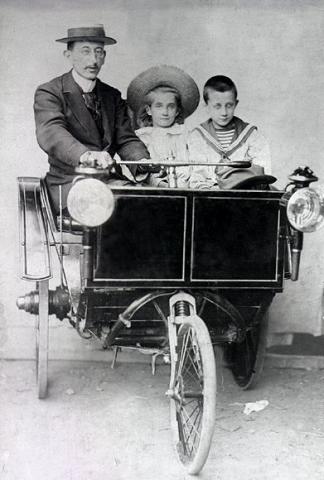
After Lavirotte returned to Lyon in 1893, the two friends began experimenting with vehicles of their own. By 1894, petrol-driven tricycles were being constructed in outbuildings on the Audibert family property along the Chemin des Quatre-Maisons, in Monplaisir. These primitive machines were influenced by Benz practice, with small horizontal engines and belt transmission. They were modest beginnings, but they supplied valuable experience in turning a stationary engine into a usable means of road transport.[6]
The Monplaisir Works: From Experiments to Industry
The first major expansion of Maurice Audibert's activities concerned steam-powered transport rather than the petrol automobile. In January 1895 he obtained a contractual right to build vehicles based on the system developed by Joanny Scotte. To undertake the work, he invested in machinery and established workshops on a property of approximately 4,000 square metres in the Rue des Quatre-Maisons. Initially known as the Ateliers de Monplaisir, the works gained practical experience in machining, assembling and testing road vehicles. The agreement with Scotte was terminated in June 1895, after which Audibert remained free to manufacture self-propelled vehicles, provided they were not steam-powered.[6]
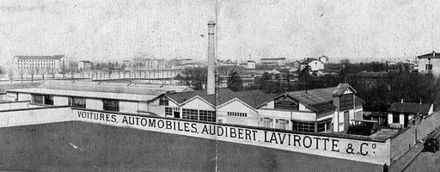
On 16 April 1896, Audibert and Lavirotte formally established their firm with an initial capital of 50,000 francs. The enterprise was located at No. 12, Chemin des Quatre-Maisons. Its position in Monplaisir proved important: the district was becoming a centre of mechanical activity, and the premises eventually passed into the hands of Marius Berliet. Period photographs of the factory convey an unusually vivid impression of the resources already required to manufacture even a comparatively small number of cars.[6]
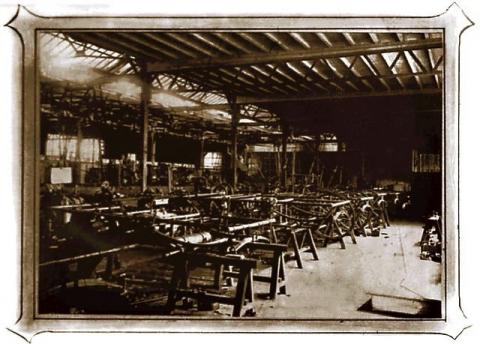
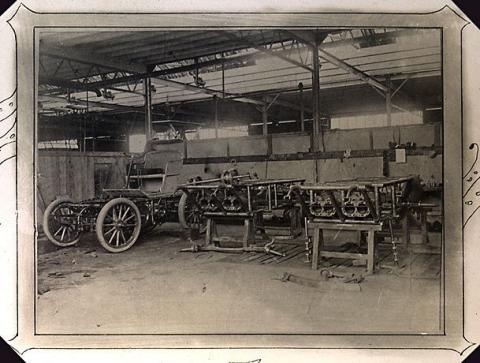
The surviving interior views show work proceeding on chassis frames and mechanical components, along with heavy machinery and shaft-driven equipment. Such images are valuable evidence of a manufacturing operation rather than simply a workshop assembling purchased carriage parts. They also demonstrate the close relationship between automobile engineering and the machine-tool trade in the late nineteenth century. These photographs document the character of the workshops, although several individual images still lack securely established dates and captions.
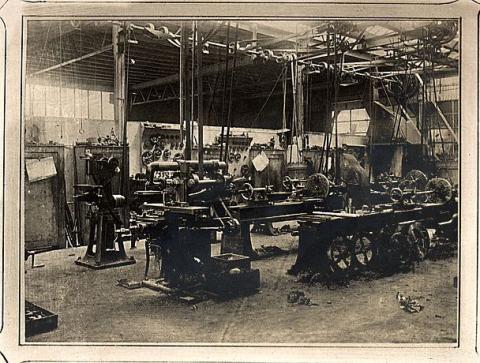
A particularly revealing contemporary article in La France Automobile insisted that Audibert & Lavirotte was not simply a company that assembled components supplied by others. It stated that the firm manufactured engines, coachwork and the other essential parts of its cars, and referred to workshops at Monplaisir and Saint-Chamond. The same report described investment in modern American machinery, claimed a workforce of more than 500 and asserted that the workshops had sometimes operated for seventeen or eighteen hours a day to meet orders. These are valuable statements about the scale and ambitions claimed by the enterprise, but their promotional tone requires caution: neither the employee figure nor the extent of the Saint-Chamond operation has been independently confirmed in the documents examined here.[11]
The factory photographs reveal rows of partly completed frames, machining stations and industrial workspaces. The very existence of such photographs does not by itself establish annual production quantities, but it demonstrates that the company had moved beyond the limited activity implied by the later anecdote of two young inventors working in a rented room. The distinction between an actual manufacturing organisation and a merely commercial distributor would also become a central theme of the company's publicity.
The First Cars and the 1896 Paris Exhibition
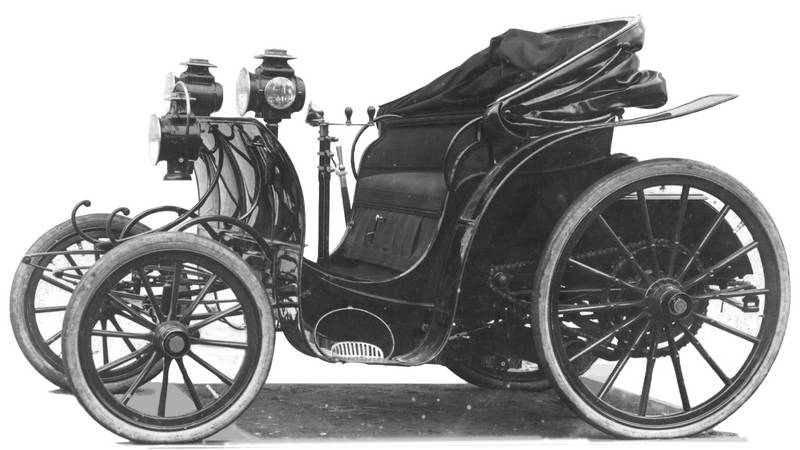
The first Audibert & Lavirotte automobiles naturally retained many features of horse-drawn carriage construction: high bodies, wooden-spoked wheels and familiar seating arrangements. Their mechanical layouts, however, were progressively adapted to the requirements of motor propulsion. Different body styles were offered, since buyers were not yet accustomed to a standardised motor car and often approached the new vehicle in the same way as a privately commissioned carriage.

One of the most striking early projects was a petrol-driven passenger omnibus based on the traditional Car Ripert body. Exhibited at the Paris Salon du Cycle in December 1896, it offered accommodation for sixteen passengers. Its two-cylinder, vertical petrol engine was carried on the front platform behind the driver. Contemporary descriptions mention water cooling by a circulating pump, electrical ignition and belt transmission. Maurice Audibert also filed French patent applications in February 1896 relating to a petrol engine and a motor vehicle, numbered 253664 and 253923 respectively.[1][4]
The omnibus was noteworthy because it extended the potential uses of petrol propulsion beyond the private carriage. Nevertheless, contemporary technical writers distinguished an interesting experimental design from a vehicle whose reliability had been proved in sustained service. The engineer Lucien Périssé described the Audibert & Lavirotte omnibus in his 1898 Automobiles sur routes, while warning against drawing premature conclusions from prototypes that had not undergone thorough road trials.[1]

In December 1896 the business underwent a financial reorganisation. Ten additional investors joined the undertaking, increasing its capital to 225,000 francs. The ability to exhibit ambitious machines, produce a variety of vehicles and acquire workshop equipment depended increasingly upon access to such investment.[7]
The Development of the Automobile, 1897–1899
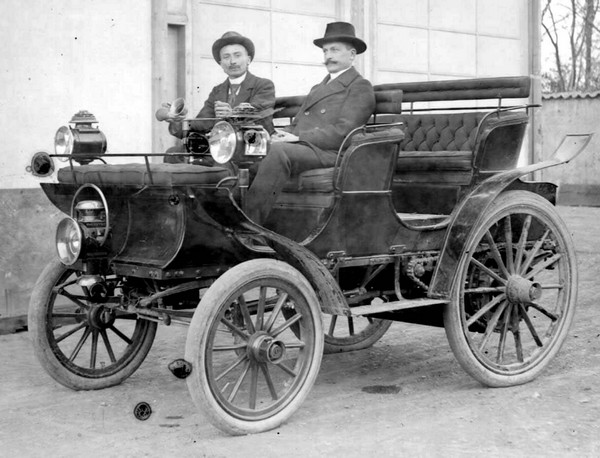
During the following years Audibert & Lavirotte progressively moved away from the direct imitation of horse-drawn coachwork. Cars with more compact bodies, lower chassis and refined controls appeared alongside the earlier high-wheel configurations. The double phaetons of 1897 illustrate the intermediate stage particularly well: their passengers still occupied a coachlike body, yet the vehicle was designed from the outset around mechanical propulsion.
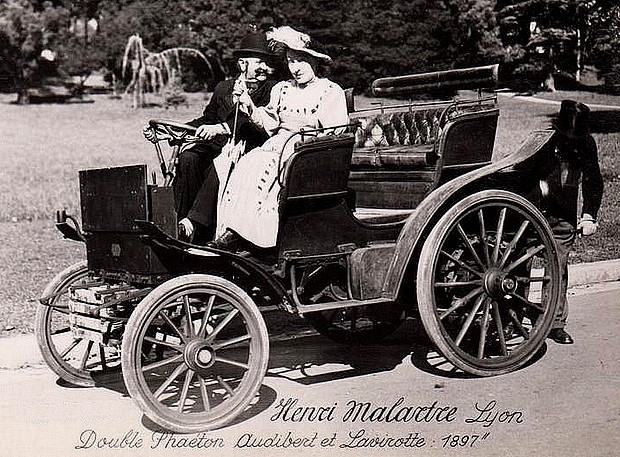
The firm's own engineering work developed alongside its use of established foreign designs. A report in La Locomotion Automobile in 1897 described an Audibert & Lavirotte car equipped with a Benz engine and electrical ignition. The same report quoted prices of 3,800 francs for a voiturette and 6,500 francs for a victoria, describing the cars' appearance favourably while noting that the writer had not been able to test one on the road.[2] The evidence therefore supports a mixed picture of early engine supply and mechanical experimentation, not an assumption that every vehicle used the same proprietary power unit. The reviewer explained that when he visited the Lyon workshops he could not find a car ready to operate, which prevented a personal test. This unusually candid reservation is as historically useful as his favourable comments upon the coachwork: a handsome machine at a show was not necessarily a reliable one on the road.
Maurice Audibert obtained patents for mechanical refinements and sought to solve practical difficulties encountered by the early motorist. In 1897, La Locomotion Automobile discussed one of his inventions intended to position a four-stroke engine appropriately for restarting. It was an example of the attention given to operating problems that would later be addressed by more standardised components and controls. The illustrated article, dated 26 August 1897, describes a device intended to stop a four-stroke engine in a position suitable for subsequent starting, using a mechanically actuated catch associated with the flywheel. Such an invention addressed one of the practical difficulties of early petrol engines, long before electric self-starters were available to motorists.[3]

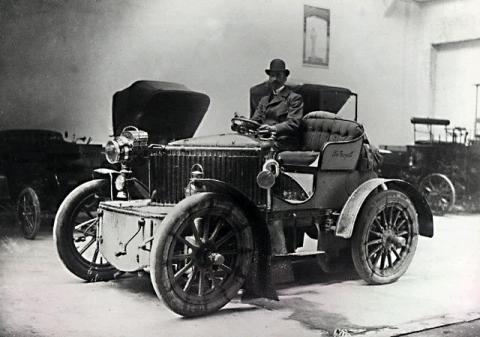
Particularly significant were developments in the chassis and transmission. By the end of the decade, the company had adopted rigid tubular structures and an enclosed change-speed mechanism. The gearbox, described in the Guide Michelin of 1900, provided four forward ratios and reverse and was controlled by a second steering-wheel-like control below the wheel used for steering.[5] Such arrangements reveal how far engineers were still from a universally accepted system of automobile controls.
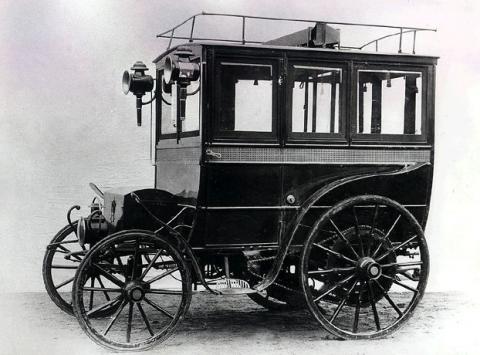
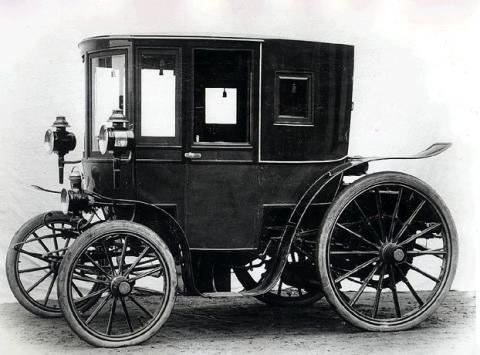
The catalogue included a broad assortment of coachwork, extending from small open cars to enclosed bodies for more protected travelling. The enclosed examples shown here underline how closely the first automobile bodybuilders initially followed carriage-making conventions, even as the mechanism underneath was becoming increasingly specialised. By the end of the decade, some Audibert & Lavirotte designs also employed the more familiar front-engine arrangement.
Seven Types of Vehicles: The Evidence of La France Automobile
Two surviving pages of the contemporary journal La France Automobile (pp. 240–241) offer a remarkably detailed view of the manufacturer's range. The illustrated report refers to seven types of vehicles rather than a single standard model, and identifies passenger cars and working vehicles side by side. Its engravings depict an omnibus, a delivery van, a works lorry, a Petit-Duc, a Wagonnette, a Victoria and a Mail-Car. This range indicates that the company was exploring several possible markets at a time when neither the private automobile nor the motorised commercial vehicle had reached a settled form.[11]
The commercial machines are especially revealing. The enclosed omnibus placed a mechanically propelled body in the familiar visual tradition of public carriages, while the delivery vehicle and the company's own lorry demonstrated the potential of the petrol motor for transporting goods. A business willing to design such different machines was not merely reproducing Benz-style pleasure cars; it was testing the commercial possibilities of the automobile throughout urban and interurban transport. The journal's account should nevertheless be regarded as evidence of what was offered or advertised, rather than proof that every model was manufactured in substantial numbers.
Among the passenger vehicles, the Wagonnette was presented as a practical machine with a fixed front windscreen. The article claimed that one example had travelled from Lyon to Paris in two days and finished third in an event between Bordeaux and Agen. The Petit-Duc was presented as a more luxurious carriage, while the Victoria and Mail-Car preserved recognisable coachbuilding forms. An enclosed travelling carriage offered protection from dust and bad weather, an increasingly important consideration as buyers began to think of the automobile as a serious long-distance means of transport. These contemporary claims are important, although the precise event classifications still require comparison with original race results.[11]
The same article speaks enthusiastically of production quality and an ability to deliver different vehicles within weeks or months, but the language is unmistakably favourable to the firm. It is therefore most valuable when read alongside the less promotional report in La Locomotion Automobile of 1897, which had praised the appearance of Audibert & Lavirotte cars while acknowledging that a road test had not been possible. Together, these contemporary accounts provide a more balanced picture of the company's industrial ambitions and its early mechanical limitations.[2][11]
The 1900 Touring Car: Chassis, Engine and Transmission
The clearest surviving technical description of the firm's mature design was published in the American journal The Horseless Age on 15 August 1900. In an illustrated article entitled "The Audibert-Lavirotte Two-Seated Voiture," the magazine reproduced a French report and supplied detailed drawings of the frame, steering gear, engine installation and transmission. Unlike the general enthusiasm of exhibition reports, this account makes it possible to examine the vehicle as a complete engineering system.[12]
The chassis employed upper and lower steel tubes connected by vertical struts and cross-members, forming a built-up girder rather than a simple pair of flat longitudinal members. The joints were brazed rather than bolted or riveted. Although the magazine recognised that this construction was expensive, it praised the rigidity of the frame and the improved alignment of bearings. Two semi-elliptic springs supported the front end, while the rear suspension employed a system of three springs, including a transverse member. The body could be removed or changed without disturbing the principal mechanical assemblies, which were carried by the frame; the water tank in the front dash was a notable exception.[12]
The engine was mounted horizontally at the front. The article specifies two cylinders for the smaller power ratings, up to 16 horsepower, and four cylinders for more powerful versions. A centrifugal governor controlled the supply of mixture, while the driver could adjust speed with an accelerator placed beneath the steering wheel. Either electric-spark or hot-tube ignition could be supplied. The valve gear and crankcase were arranged with maintenance in mind, and the engine used a relief cam during starting instead of the more familiar compression-release cocks. Water circulated between the engine and an elevated tank by gravity, without a mechanical pump. The magazine reported the manufacturer's claim that the supply could last for some 300 miles without replenishment; that figure should not be read as an independently measured test result.[12]
Power passed from the engine through a belt to an intermediate shaft, with a foot-operated jockey pulley controlling belt engagement. The actual changes of ratio were made by enclosed gears, selected with a small second hand wheel mounted immediately below the steering wheel. Through bevel gearing, a shaft and a grooved cam drum, this control moved the gear selectors, allowing a direct change between widely separated ratios without traversing each intermediate speed. The change-speed gears, differential and reversing mechanism were enclosed in an oil-filled aluminium casing, with nickel-steel gears and additional bearing lubrication. Sprocket wheels on the rear wheels indicate the chain-drive arrangement used to transmit the final drive. In the days before conventional gear levers and pedal layouts had become standard, this system represented a sophisticated but distinctly individual solution.[12]
The technical article also described two independent braking arrangements: bands on the rear wheels operated by a hand lever, together with a brake acting upon the differential shaft and controlled by a pedal. Such redundancy was particularly valuable on contemporary roads, where long descents and unreliable traction presented serious risks. Read as a whole, the 1900 design shows a manufacturer whose engineers were no longer merely adapting carriage forms but addressing the combined demands of steering, suspension, lubrication, cooling, accessibility and control in a genuinely integrated automobile.
Publicity, Competitions and Exhibitions
Like other manufacturers of the pioneering period, Audibert & Lavirotte recognised the publicity value of automobile competitions. Road races, reliability trials and hill climbs were opportunities to demonstrate performance and durability at a time when potential purchasers were still uncertain whether cars could undertake long journeys. The firm's cars appeared in several competitions between the late 1890s and 1901. Some results remain to be verified against original entry lists and contemporary newspaper reports, rather than repeated from later summary tables.

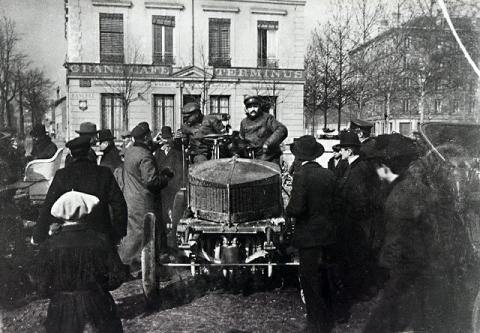
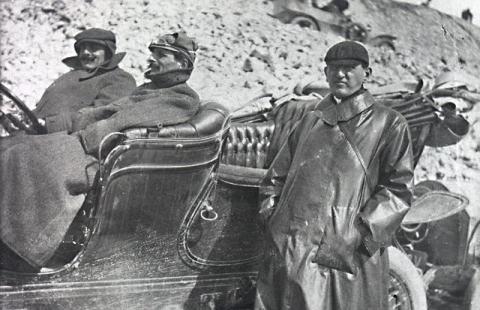
The photographs of crowds, drivers and machines are particularly evocative of early competitions. Where the event or occupants have not been securely identified, the captions deliberately avoid attaching a specific race or date. Such photographic evidence will be easier to interpret in conjunction with contemporary race reports.
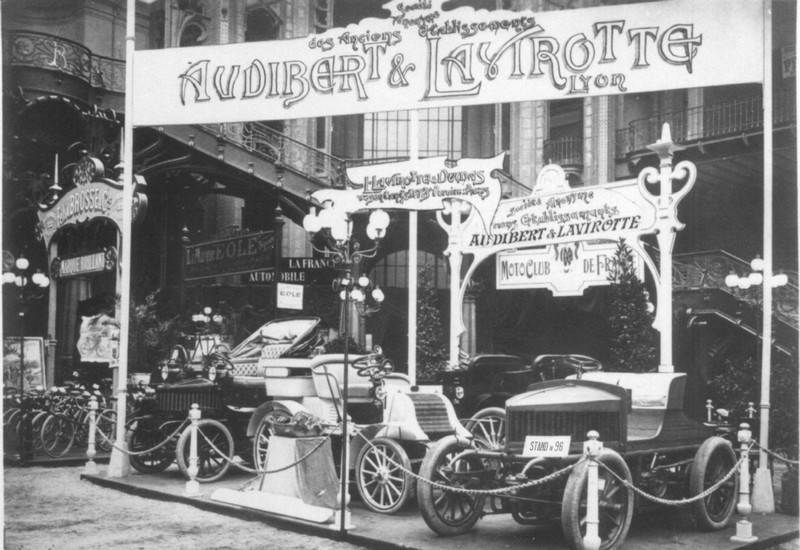
Exhibitions were equally important. Participation in salons brought a provincial manufacturer before a national and international audience, while decorated stands, printed advertising and illustrated catalogues presented motor cars as serious commercial products. A surviving photograph of the Audibert & Lavirotte exhibition stand shows an elaborate presentation of several vehicles. The precise exhibition and date remain to be confirmed.
The Last Years and the Transfer to Berliet
By 1900 the firm possessed accumulated manufacturing experience, a varied catalogue, technical patents and an established public identity. Yet the financial conditions of the automobile industry were becoming more demanding. Larger engines, more sophisticated transmissions and fully equipped production facilities required considerable investment, while the relatively small output of individual manufacturers made capital recovery uncertain. The company's promising range could not shield it from these pressures. Moreover, newspaper descriptions of a busy factory are not accounts of its balance sheet: the size of the enterprise, the number of cars sold and the profitability of operations must remain distinct questions.
At an extraordinary general meeting on 27 November 1901, the shareholders decided to discontinue automobile production and dissolve the enterprise. This brought to an end an industrial undertaking that had been active through nearly the whole first experimental decade of the French motor car. In June 1902, Marius Berliet arranged to acquire the former Audibert & Lavirotte facilities at Monplaisir. The site became an important part of his manufacturing operations and helped lay the foundations for Lyon's subsequent growth as an automotive centre.[6][7]
The Founders' Later Careers and the Historical Legacy
The closure of the company did not end the mechanical careers of its founders. Émile Lavirotte later became associated with Marius Berliet, while Maurice Audibert worked with Rochet-Schneider and La Buire. Audibert also investigated other technical fields, including experiments connected with colour cinematography. Both men thus remained involved in the engineering culture that had led them to automobile construction in the first place.[7]
Published estimates of the number of vehicles built vary widely, from several dozen to approximately two or three hundred. Since no complete original production ledger has been established here, none of these figures should be presented as an audited factory total. Whatever the precise number, the surviving cars, photographs, patents and advertising material provide compelling evidence of a manufacturer that participated in the transformation of early motor transport. In 1928, the former Rue des Quatre-Maisons was renamed Rue Audibert-et-Lavirotte in recognition of the pioneers. Their names remain part of Lyon's urban landscape, even as the factories that succeeded their venture have themselves passed into history.
Historical Sources and References
1. Lucien Périssé, Automobiles sur routes (Paris: Gauthier-Villars / Masson, 1898), pp. 165–166, description of the Audibert & Lavirotte omnibus. Digitised edition.
2. La Locomotion Automobile, first half of 1897, contemporary report on the Audibert & Lavirotte vehicles, their engines and prices. CNAM digital collection.
3. La Locomotion Automobile, no. 34, 26 August 1897, p. 393, "Un perfectionnement des moteurs à pétrole par M. Audibert". CNAM digital collection.
4. French patents nos. 253664 and 253923, attributed to Maurice Audibert (February 1896); see archival patent documentation reproduced in the Thésaurus of Les 3A Historique.
5. Guide Michelin pour les chauffeurs et les vélocipédistes, first edition (1900), pp. 302–303, technical account of the firm's transmission system.
6. Inventaire général du patrimoine culturel, Auvergne–Rhône-Alpes, Usine de construction automobile Audibert-Lavirotte puis Marius Berliet, dossier IA69000004. Official industrial heritage inventory.
7. Historical studies of Audibert & Lavirotte and the early Lyon industry, drawing upon the Fondation Marius Berliet and departmental archival materials; supplementary period records include company reorganisations and proceedings of 27 November 1901.
8. Society of Automotive Historians in Britain, "Snapshot 7: 1900 Audibert et Lavirotte." Historical commentary.
9. James M. Laux, In First Gear: The French Automobile Industry to 1914 (1976).
10. Original photograph attributed to Maurice Audibert, described as originating from a contemporary glass-plate negative (1897). Photographic source record.
11. La France Automobile, "Les Voitures Audibert-Lavirotte", pp. 240–241. Contemporary illustrated article with seven vehicle categories, factory and production claims, and road-travel anecdotes. Facsimiles supplied from the author's collection; exact issue date not established from these pages.
12. The Horseless Age, vol. 6, no. 20, 15 August 1900, pp. 17–19, "The Audibert-Lavirotte Two-Seated Voiture". Technical description and original diagrams. Historical periodical archive.