
Briscoe Frères: The Ajax Cyclecar and the Briscoe Light Car (1913–1914)
An American industrial venture in France on the eve of the First World War
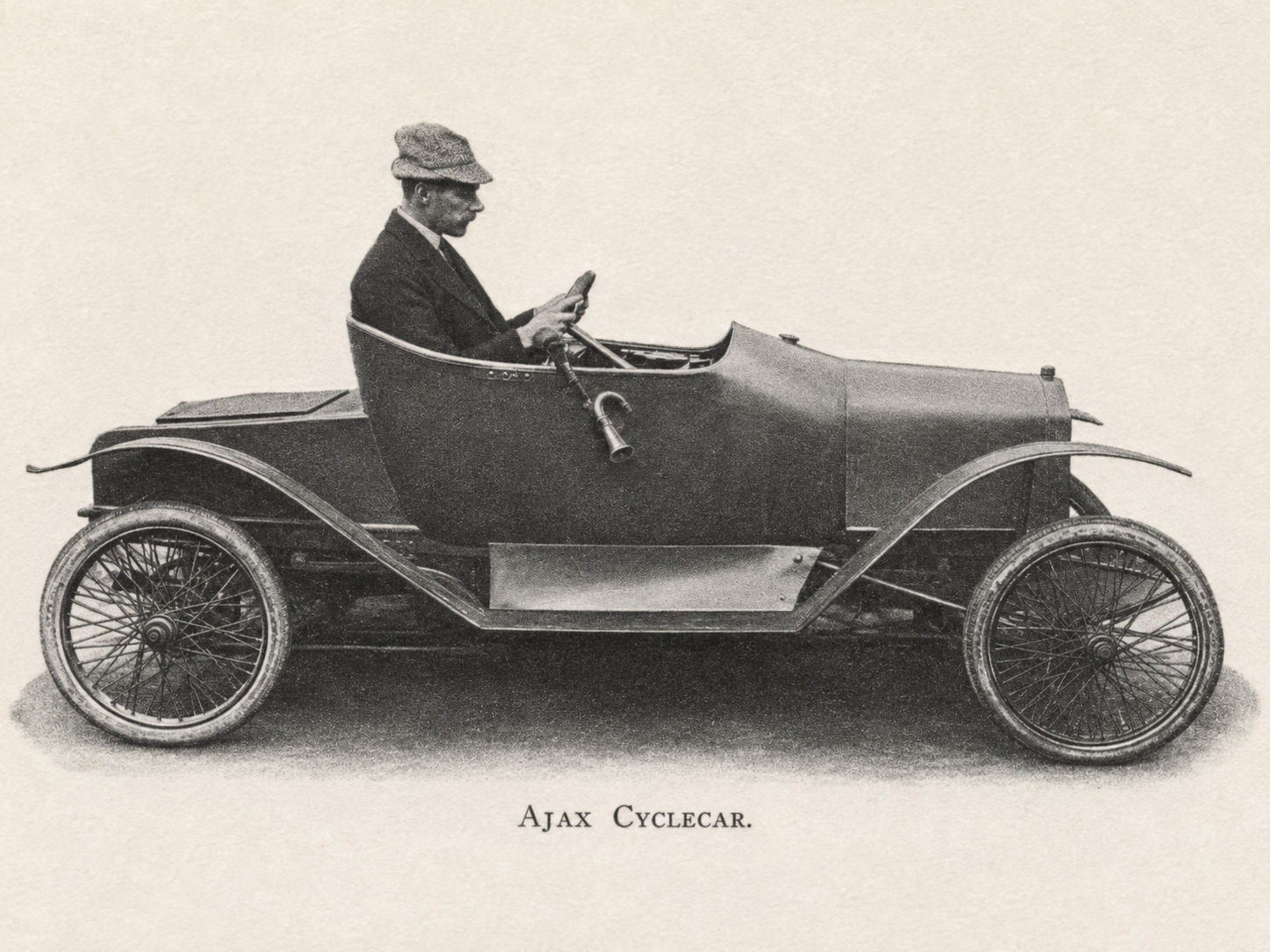
In 1913, two American brothers, Benjamin and Frank Briscoe, established an unusual automotive venture in France. Their company, Briscoe Frères, sought to combine American manufacturing experience with European engineering and coachwork. At the Paris Motor Show that year, it presented not one but two distinct cars: a conventional five-passenger light car bearing the Briscoe name and a small two-seater called the Ajax. Although developed under the same roof, the two machines differed fundamentally in their engines, drivetrains and intended markets.
Our principal contemporary source is the illustrated technical report “Briscoes Enter Market with Light Car and Cyclecar”, published in The Horseless Age on 22 October 1913 (Vol. 32, No. 17, pp. 695–696). The report describes both vehicles in considerable mechanical detail, including their engines, lubrication systems, transmissions, final drives and suspensions. The following account retains these details while distinguishing the two designs and identifying a few points that still require further documentary evidence.
The Briscoe brothers and the creation of Briscoe Frères
Benjamin Briscoe (1867–1945) was an important figure in the formative years of the American motor industry. His activities had included automotive component manufacturing and the Maxwell-Briscoe enterprise. He subsequently helped organize the United States Motor Company, an ambitious consolidation of automobile manufacturers that included Maxwell-Briscoe, Columbia and Brush. The consolidation encountered serious financial difficulties, and by 1912 Briscoe had lost control of the enterprise.
Benjamin then embarked upon a new undertaking with his brother Frank Briscoe. Instead of merely importing an existing American design, they established a company in France under the name Briscoe Frères (“Briscoe Brothers”). According to the contemporary account, the cars were developed in Paris by American and European engineers working under American commercial direction. The journal characterized the result as a combination of American manufacturing methods and European design.
The Horseless Age supplied a precise business address: 30, rue du Point-du-Jour, Billancourt, Seine, France. A later reference work edited by G. N. Georgano places Briscoe Frères at Neuilly, Seine. Without independent company records it is not possible to establish whether Neuilly was a registered address, another business location or simply an error. For the workshop associated with the 1913 cars, the contemporary Billancourt address is the stronger evidence.
The significance of this enterprise lies partly in its timing. France was a major centre of European automobile engineering, while the Briscoes brought experience from an American industry increasingly concerned with simplified construction and production economies. Their French project attempted to unite these different traditions just before the First World War disrupted industrial and commercial plans across Europe.
Two automobiles at the 1913 Paris Motor Show
The larger vehicle was the Briscoe Light Car, a five-passenger automobile with a conventional three-speed gearbox, propeller shaft and bevel-gear final drive. The smaller Ajax Cyclecar was a two-seater with a four-cylinder engine, a friction transmission and a single-chain final drive. The term cyclecar was then commonly applied to inexpensive, lightweight automobiles occupying the space between motorcycles and standard touring cars.
| Specification | Briscoe Light Car | Ajax Cyclecar |
|---|---|---|
| Seating | Five passengers | Two passengers |
| Engine | Four cylinders, 80 × 130 mm bore and stroke | Four cylinders, 57 × 96 mm bore and stroke |
| Displacement, calculated | Approximately 2,614 cm³ | Approximately 980 cm³ |
| Power quoted in 1913 | 16 hp in the model announcement; reportedly 32 hp at 1,800 rpm on a bench test | 8–10 hp, as reported by The Horseless Age |
| Transmission | Three forward speeds and reverse; propeller-shaft drive | Variable-ratio friction transmission; single chain to rear axle |
| Reported complete-car price | Approximately US$900 | US$390 |
Source for the comparative specifications and prices: The Horseless Age, 22 October 1913, pp. 695–696. Displacements are calculated from the published bore and stroke, not quoted directly in the period report. The figures for rated power and bench-test power should not be treated as measurements obtained under identical conditions. American-dollar prices are those reported by the American journal, not verified French retail quotations.
Georgano subsequently gave an Ajax price of £78, whereas the 1913 American article reported US$390 for the fully equipped cyclecar. The difference should not be resolved by a simple currency conversion without knowing the intended market, date, specification and basis of each quotation.
The Briscoe Light Car: the five-passenger model
The larger Briscoe was intended to offer the accommodation and equipment of a regular passenger automobile without excessive weight. Its designers pursued a compact power unit, a relatively simple chassis and the use of high-quality steels, including chrome-vanadium steel, in selected components.
Engine construction and valve gear
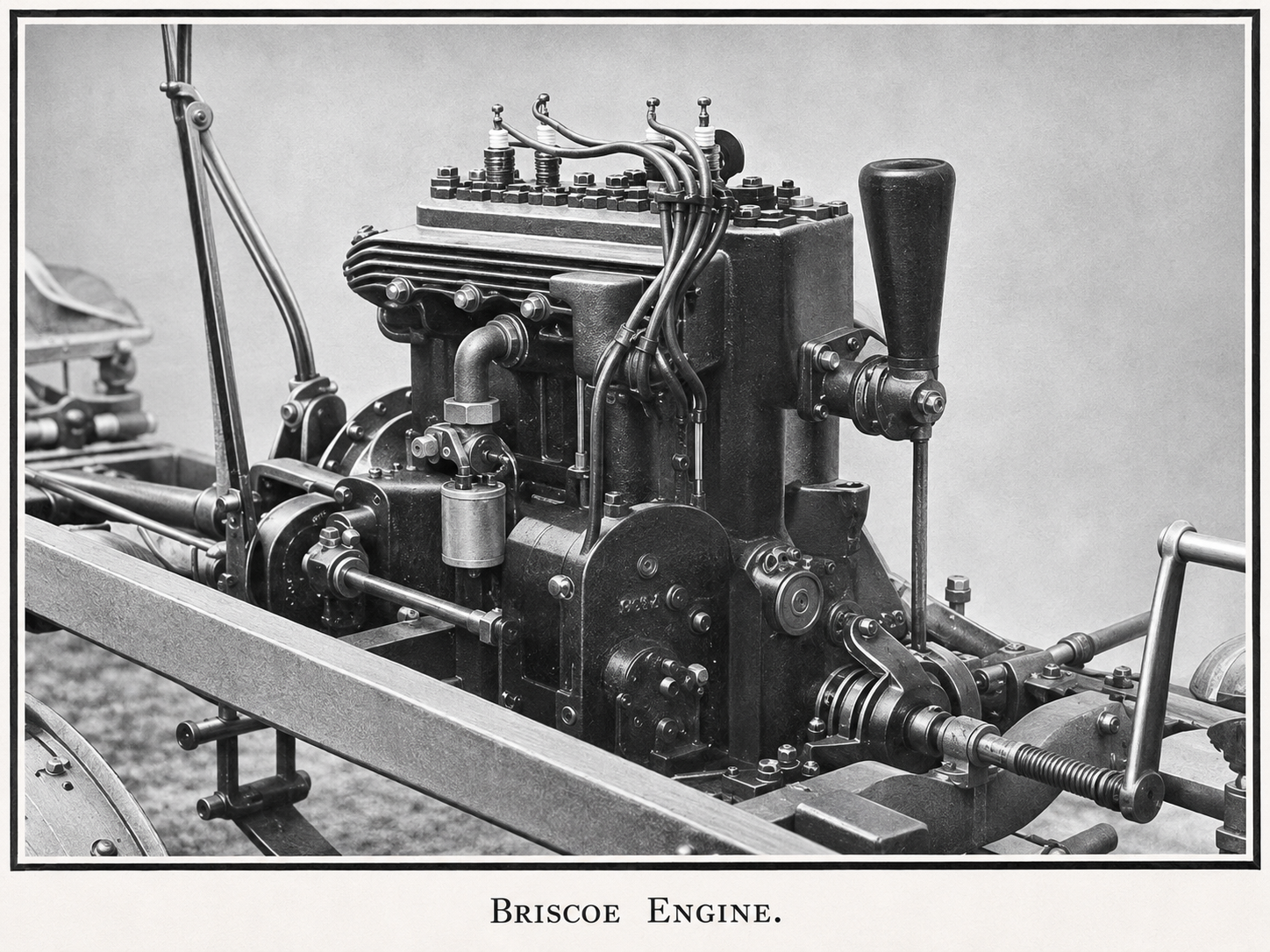
The four-cylinder engine had a bore of 80 mm and a stroke of 130 mm, giving a calculated displacement of approximately 2.61 litres. Although the automobile was announced with a 16 hp engine, the magazine reported a bench-test output of 32 hp at 1,800 rpm. The different figures should be preserved in their original context rather than treated as contradictory measurements of the same rating.
The cylinders formed a monobloc casting. The cylinder block and the upper crankcase also constituted one compact casting, while the lower oil sump was a separate stamped-steel component fastened by bolts. The crankshaft, described as 1⅞ inches in diameter, ran in two long plain bearings. The valves were grouped on one side of the engine beneath a cover; their adjustable tappets had fibre tips intended to reduce operating noise.
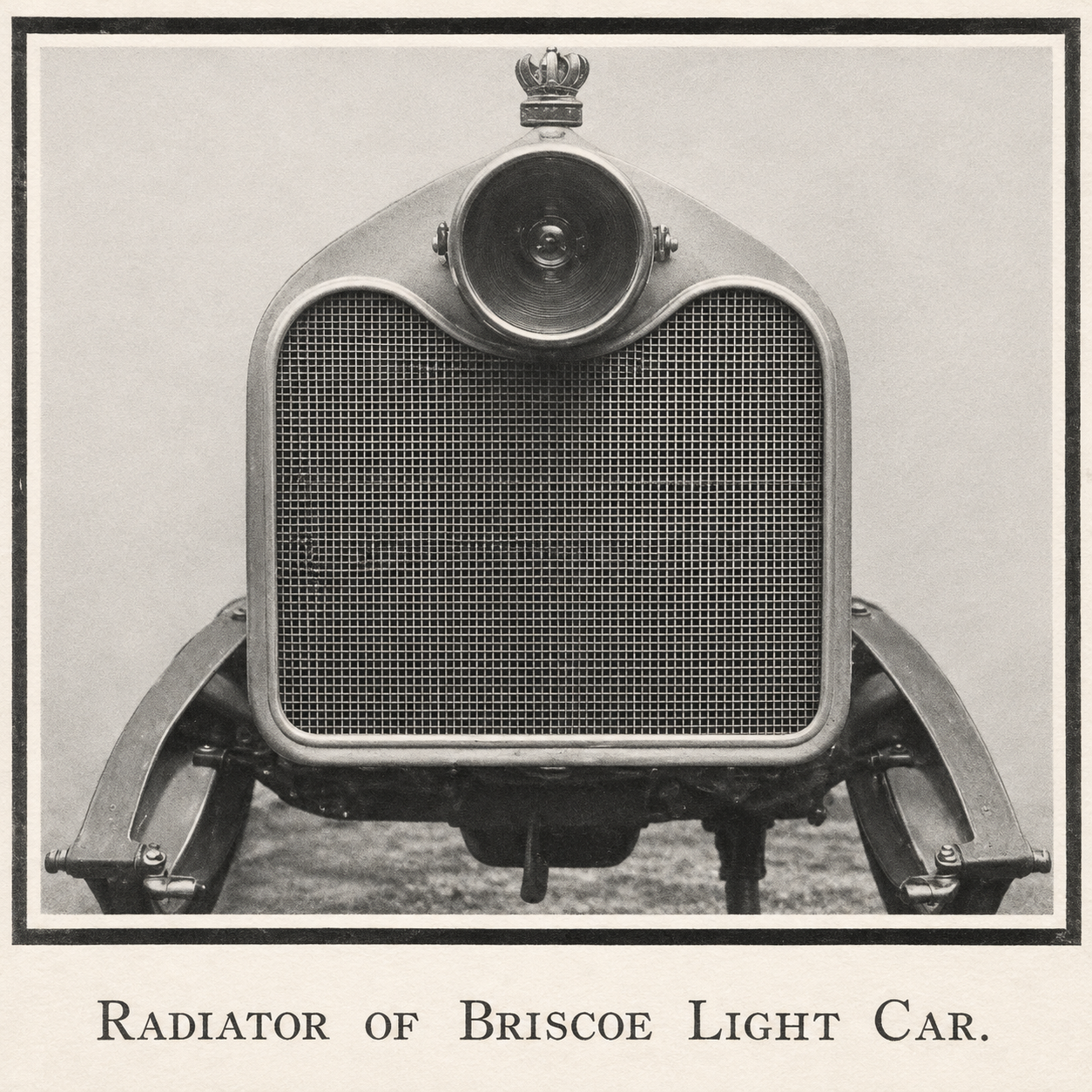
Cooling was by thermosiphon circulation, with large-diameter pipes and a patented radiator incorporating flat copper tubes. A two-bladed fan of what the journal called an aeroplane type was driven by a flat belt from the crankshaft. The ignition system used a high-tension magneto on the right side of the engine, driven by the timing gears at its rear.
An automatic carburettor was mounted on the left side of the engine. The charge was warmed by the exhaust manifold before entering the cylinders, and exposed external pipework was kept to a minimum. Lubrication was described as positive: a plunger pump on the left drew oil from the crankcase and sent it through a sight feed on the dashboard to the two main crankshaft bearings and to constant-level troughs below the connecting rods. This arrangement combined pump delivery with oil troughs; it should not be confused with a modern fully pressure-fed lubrication system.
Gearbox, final drive, chassis and equipment
The engine had a three-point mounting. Two arms cast at the rear of the cylinder group partly surrounded the flywheel and supported an unusually compact gearbox. It provided three forward speeds and reverse, with a conventional gated change. The gear and brake levers were situated on top of the gearbox, making them accessible and leaving entry to the front seats comparatively unobstructed. Either right-hand or left-hand steering could be supplied.
Power reached the rear axle through a long propeller shaft and a bevel-gear final drive. The shaft ran inside a torque tube with a spherical joint, while the rear axle was of the full-floating type. Chrome-vanadium spring steel was used for the axle shafts and propeller shaft; according to the magazine, their resilience helped the driveline take up torque smoothly, particularly when starting on difficult ground.
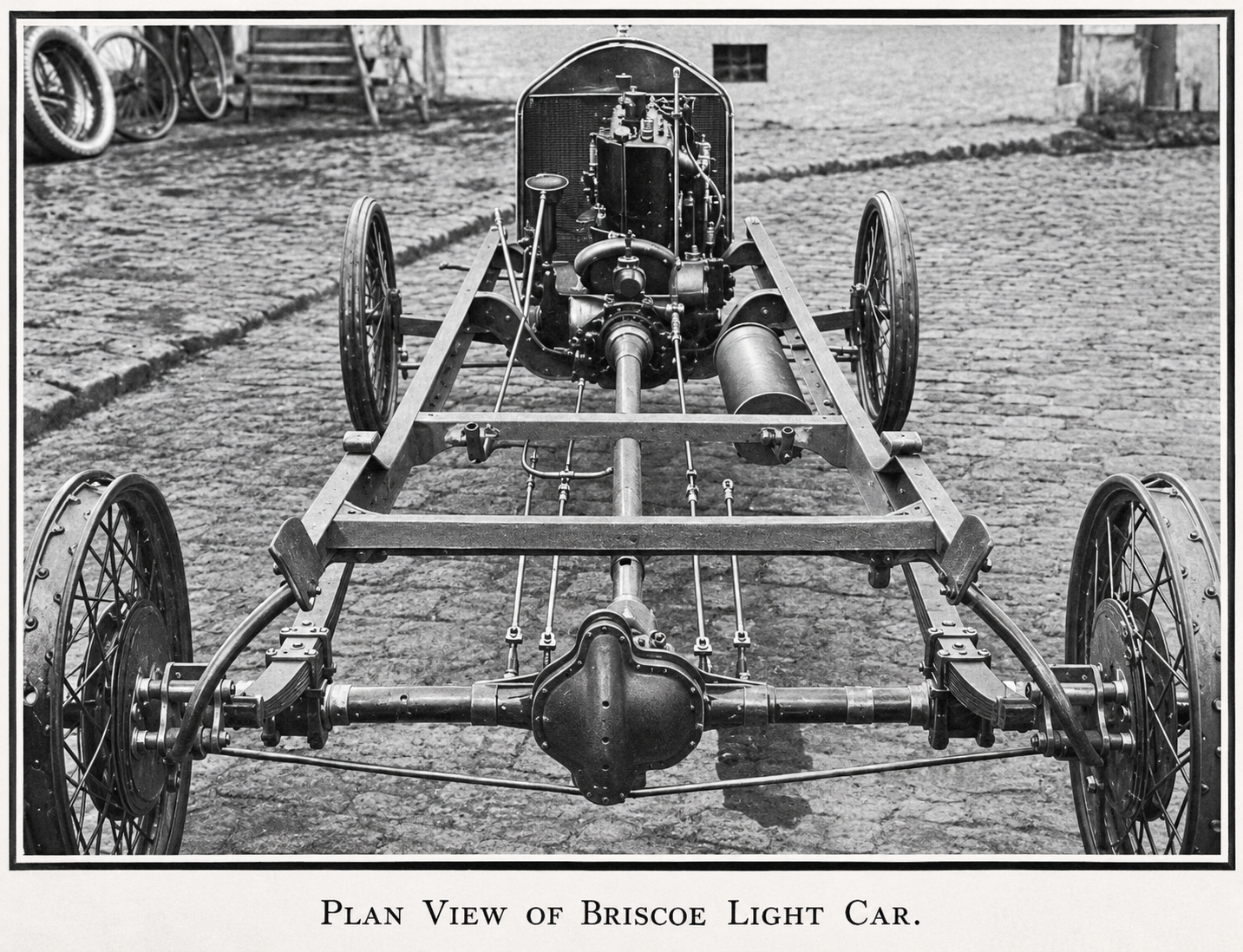
All four wheels were suspended on semi-elliptic leaf springs. Wire-spoked wheels were fitted, with provision for carrying a spare tyre at the rear. The period report gave the tyre size as 30 × 3½ inches, the wheelbase as 105 inches (about 2,667 mm) and the track as 56 inches (about 1,422 mm). The chassis weight was stated to be 980 lb (approximately 445 kg).
The petrol tank was carried beneath the cowl dashboard. The body adopted contemporary European lines, and the standard specification included electric lighting with the main headlamp integrated into the radiator header. The lamps were supplied by a storage battery; a dynamo could be fitted at additional cost. The advertised complete automobile also included a body, folding top, windscreen, tyres and speedometer.
The Ajax Cyclecar: a four-cylinder engine of approximately 980 cm³
Ajax was the smaller and less expensive member of the Briscoe Frères programme. It combined a light, two-seat torpedo body with a water-cooled four-cylinder engine and a friction transmission in place of the Light Car’s ordinary gearbox. The contemporary report stated explicitly that this smaller machine was to be marketed under the name Ajax.
Cylinders, valve gear and ignition
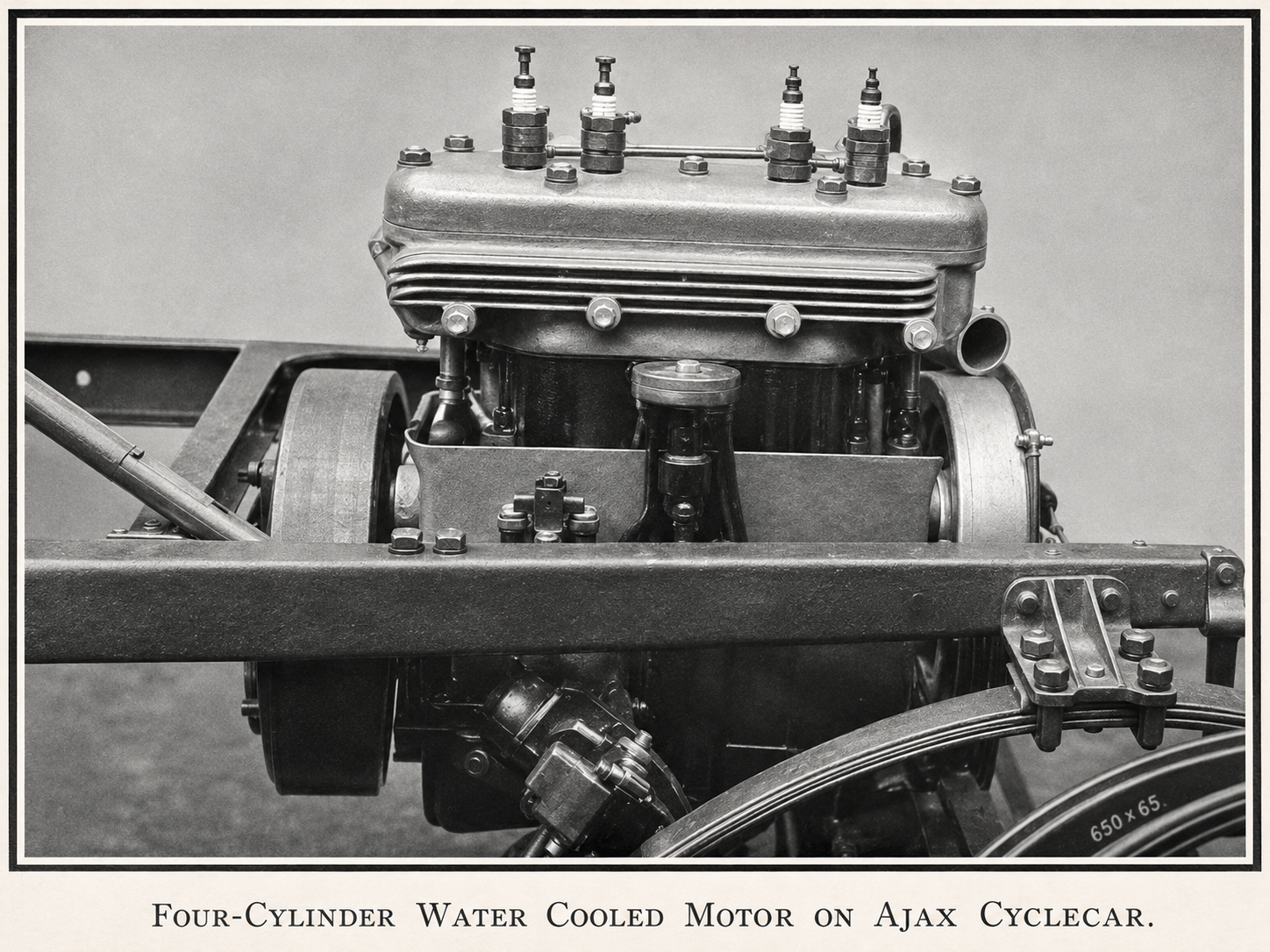
The Ajax engine had a 57 mm bore and 96 mm stroke. These dimensions yield a calculated total displacement of about 980 cm³. The Horseless Age gave its rating as 8–10 hp; Georgano’s later encyclopedia gives 12 hp. Because the basis of these ratings is not established, the two figures should not be silently substituted for one another.
The cylinder block and crankcase were made as a single casting, with a detachable pressed-sheet-steel oil sump below. The cylinder head was removable, allowing carbon deposits to be cleaned out more easily. The relatively large valves were all arranged on one side of the engine and operated by a camshaft machined from the solid. Adjustable tappets had fibre tips to deaden mechanical noise.
The tappet guides incorporated shallow annular wells and return passages so that oil escaping alongside the guides could drain back to the crankcase. A high-tension magneto was mounted accessibly on the left side of the engine, with the sparking plugs set directly above the inlet valves. Unlike the larger Briscoe engine, the Ajax had its timing gears at the front.
Cooling, lubrication and carburation
The cooling system relied on thermosiphon circulation, the movement of water being driven by its changes in density as it was heated and cooled. The radiator contained flat copper tubes. The period article does not establish the presence of a mechanically driven water pump, and none should be inferred from its description.
A small oil pump on the right side of the crankcase drew oil from the sump and supplied the two main crankshaft bearings and troughs beneath the connecting rods. Before reaching the bearings, the oil passed through a dashboard sight-feed device, giving the driver visual confirmation that lubrication was taking place.
The automatic carburettor was bolted directly to the intake piping, which was incorporated with the exhaust manifold. This arrangement warmed the incoming mixture before it entered the combustion chambers. It reflected a common early-engine concern: improving fuel vaporisation without an unnecessarily complicated intake system.
The Ajax friction transmission: how it worked
Perhaps the most distinctive mechanical feature of Ajax was its friction-drive transmission. This was not simply an ordinary friction clutch placed ahead of a gearbox: the friction mechanism itself provided a changeable speed ratio, avoiding the conventional stepped gear train fitted to the larger Briscoe Light Car.
According to the contemporary description, the longitudinal shaft from the flywheel incorporated a slightly flexible connection and carried a large driving friction disc at its rear end. The disc was located between two frame crossmembers, beneath the driver’s seat. A driven friction member with a compressed-paper facing was fitted to a transverse shaft. A side lever moved the driven member along that shaft, bringing it into contact with the driving disc at different distances from the disc’s centre.
Moving the contact point changed the peripheral speed imparted to the driven member and therefore altered the overall transmission ratio. A powerful spring associated with the disengaging mechanism maintained contact between the two friction surfaces. The description is sufficiently detailed to establish the principle, but it does not include a complete engineering drawing of the control mechanism. The precise arrangement of every lever position, including the method of obtaining reverse, should therefore not be invented.
The design employed an especially interesting load-sensitive contact-pressure arrangement. When starting or climbing a steep hill, the pull in the final-drive chain provided extra force pressing the friction surfaces together. The driven friction shaft was allowed to pivot slightly in a spherical S.K.F. bearing mounted on a bracket attached to a frame crossmember. At low speed, chain tension acted through a relatively favourable lever arm, increasing the clamping force. As the driven member approached the centre of the main driving disc, the corresponding lever arms shortened. In this way the mechanism used part of the reaction generated by the transmission itself to assist the frictional grip when higher traction was required.
The magazine reported that ball bearings were used throughout the transmission. The surviving description gives a clear functional outline, but a contemporary detailed drawing or an original assembly would still be required to settle the exact geometry of the pressure-regulating system.
Chain drive, suspension and bodywork of the Ajax
A single chain carried power from the friction transmission to the rear axle. The two rear wheels were positively driven together, without a differential. This eliminated one costly component, but during a turn the two rear wheels could not independently rotate at the different speeds normally required by their unequal paths; the resulting difference had to be accommodated by tyre slip or compliance within the system.
The rear suspension used an unusual form of cantilever spring arrangement. The short forward arm of the spring turned downward and carried the radius rod. At the front, the suspension employed full-elliptic springs. Steering was described as being of the ordinary type.
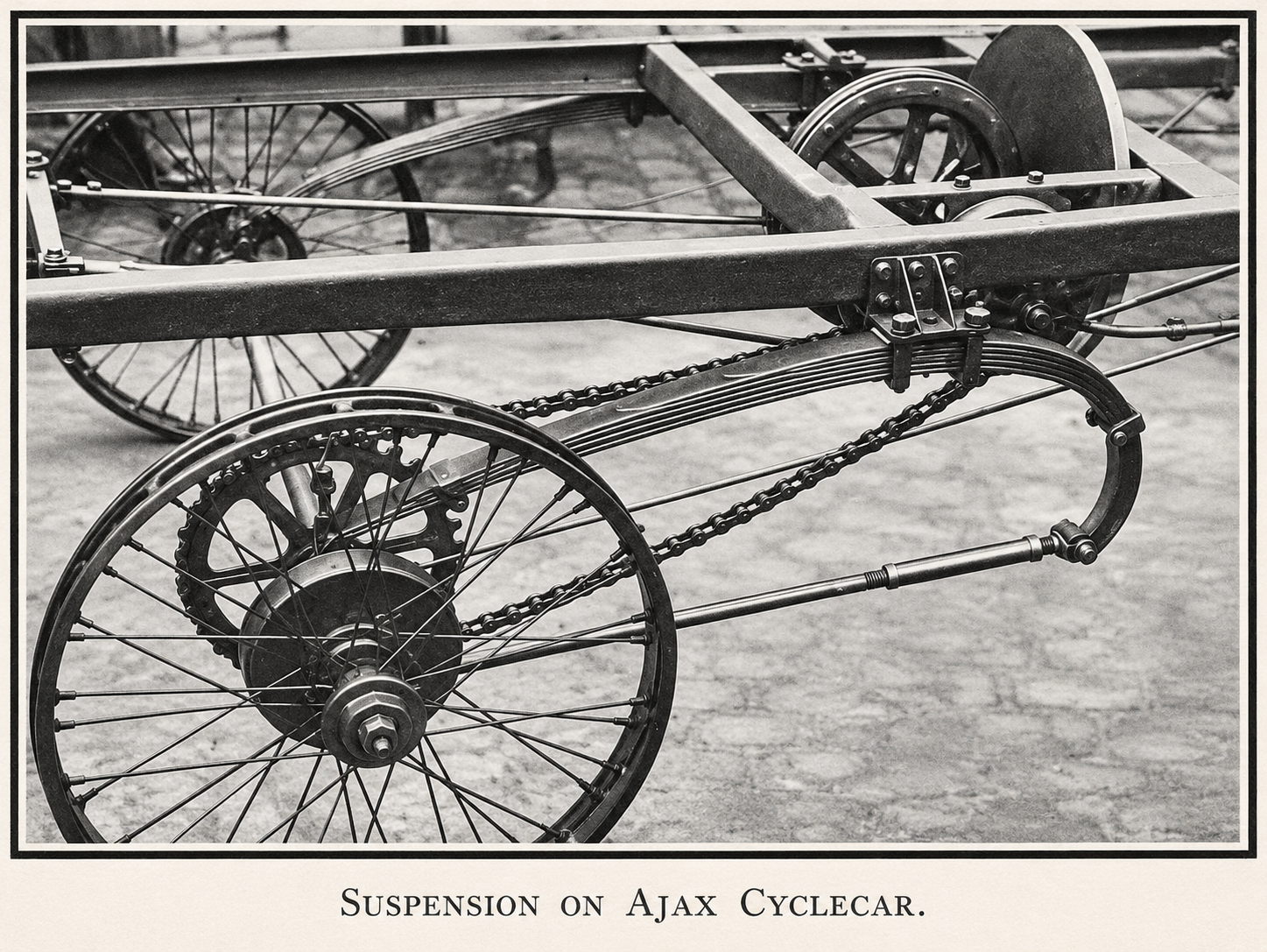
The detachable wire wheels carried 650 × 65 mm tyres. The torpedo-type two-seat body housed its petrol tank within the cowl dashboard. At the rear were a compartment for tools and a platform intended to carry luggage. Altogether the car embodied the cyclecar movement’s attempt to produce practical individual transport with fewer components, lower weight and a correspondingly lower advertised price.
From the French venture to Argo and American Briscoe automobiles
Later reference works generally date the French Ajax venture to 1913–1914. The outbreak of the First World War disrupted the brothers’ intentions for large-scale manufacture. What is not yet established is the number of Ajax cars actually completed or sold. It would be incorrect to present planned mass production as proof that extensive production took place.
After their French venture, the Briscoes resumed automobile activity in the United States. The American Argo was closely related to the Ajax concept, but Georgano distinguishes it by its conventional transmission. Consequently, the technical details of the French friction-drive Ajax cannot automatically be applied to Argo.
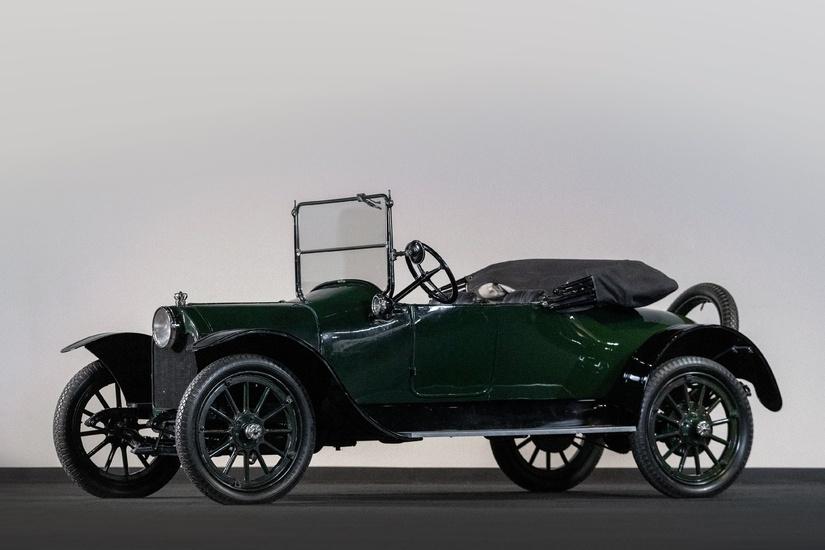
Benjamin Briscoe also established the Briscoe Motor Corporation, associated with automobile manufacture in Jackson, Michigan, from 1914 onward. The cars were promoted as combining French design influence with American production and pricing. Although the American cars and the 1913 French venture shared the Briscoe name and the same entrepreneurial background, they should not be described as mechanically identical without model-specific evidence.
Historical and technical significance
Briscoe Frères was a short-lived endeavour, but its two automobiles illustrate different approaches to the same early-twentieth-century problem: how to bring the automobile within reach of a wider market. The five-passenger Light Car sought moderate cost and weight without abandoning the conventional gearbox and shaft drive. Ajax went further in reducing complexity through a friction transmission, chain final drive and elimination of the differential.
For the historian of automotive technology, Ajax is particularly interesting because its transmission used chain tension to influence the normal force between the friction elements. For the historian of the industry, Briscoe Frères records an unusual attempt to bring American automobile-making experience into a French workshop shortly before the First World War. These features make the story of the firm more substantial than its brief dates of operation might suggest.
Historical sources
- “Briscoes Enter Market with Light Car and Cyclecar.” The Horseless Age, 22 October 1913, Vol. 32, No. 17, pp. 695–696. The principal contemporary source for the French firm, both vehicles and the technical descriptions.
- G. N. Georgano (ed.). The Complete Encyclopedia of Motorcars, entry “AJAX (iii) (F) 1913–1914.” Used for the Briscoe Frères identification, the alternative 12 hp rating, the reported £78 price and the connection with Argo. Edition and page number should be entered from the consulted copy.
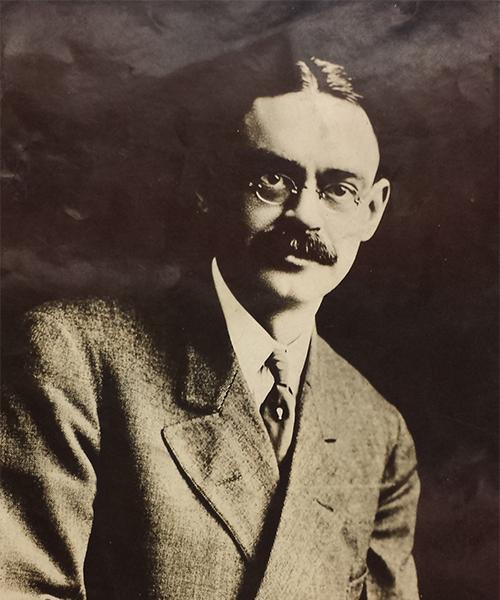
- Frank Briscoe portrait. Michigan Manufacturer & Financial Record, Vol. 2, No. 33, 1910. Image and source information at Wikimedia Commons.
- Robert Tate. “Remembering the Briscoe Automobiles”, MotorCities, 16 May 2018. Background on American Briscoe production.
- Jim Hinckley. “Benjamin Briscoe — Part Three”, Motoring NZ, 2020. Discussion of Argo and the later Briscoe venture.
- 1915 period advertisement. NZ Motor & Cycle Journal, 25 April 1915, p. 80. A contemporary advertisement describing the French design claims made for American-period Briscoe automobiles; treated here as advertising evidence rather than independent proof of manufacturing arrangements.
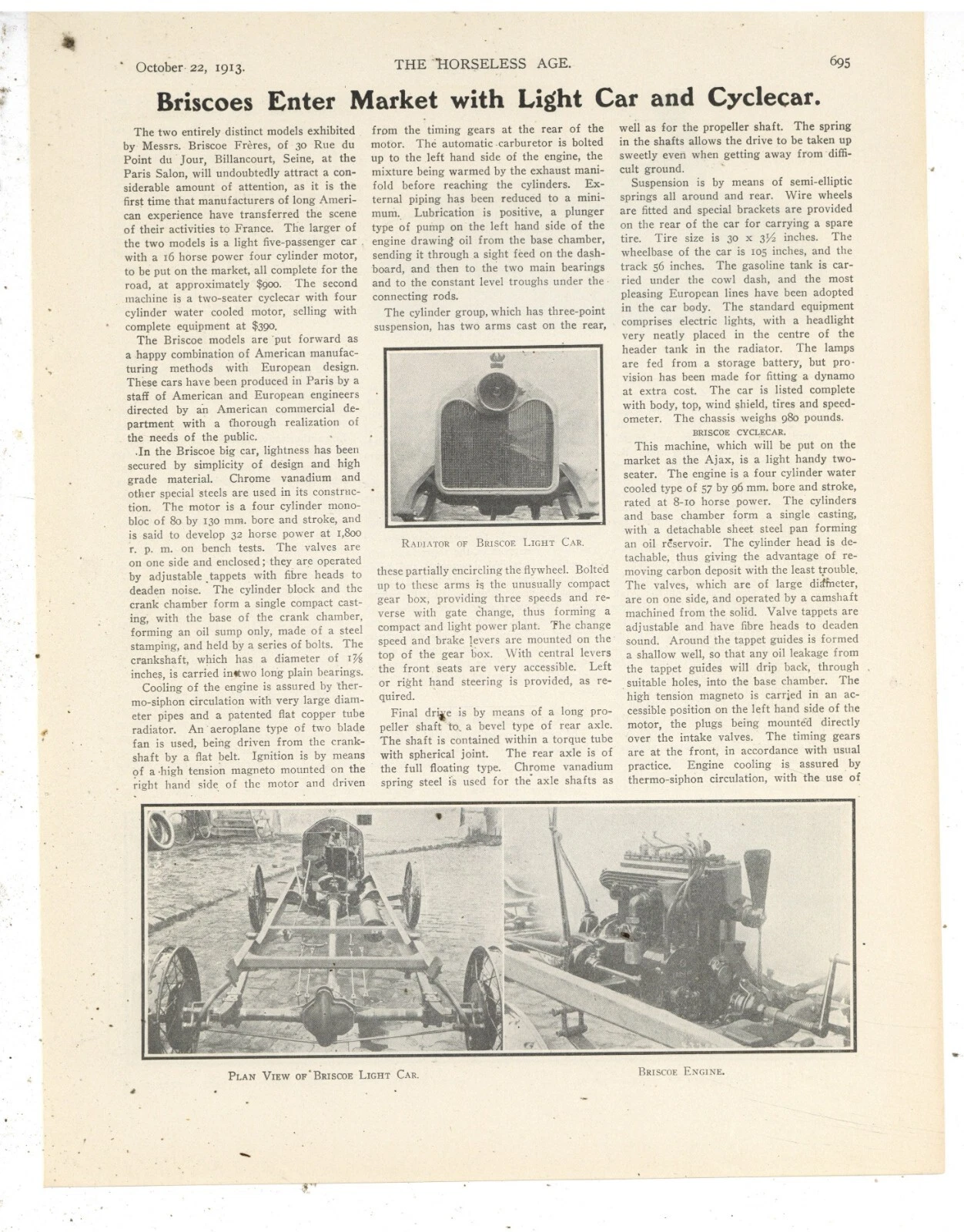
The illustrated historical photographs have been digitally reconstructed for presentation. For precise mechanical details, consult the original 1913 journal illustrations and descriptions.